I always wondered how quickly the tides actually change. If the moon is directly overhead, does the tides at the lowest or the highest? Or does it just pushes things around and it’s just different?
Think about the moon like a flashlight beam. Where the center hits the ocean, it keeps a consistent pull upwards, and moves the bulge of water as it orbits. Towards the edges of focus, it’s dropping a bit of water and it’s rippling away as it falls. I am no scientist, but I liked this explanation when I saw it because it was simpler to understand.


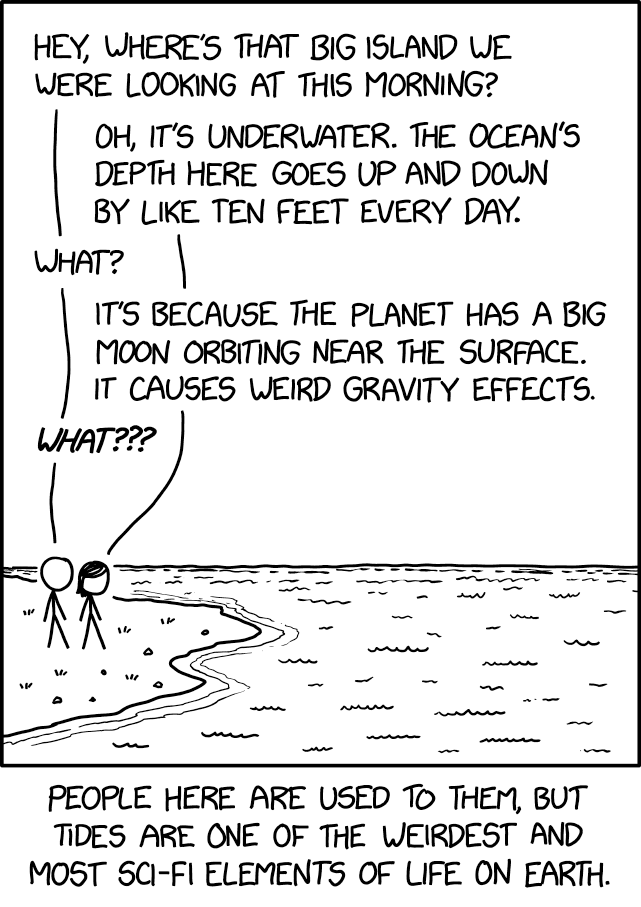
I always wondered how quickly the tides actually change. If the moon is directly overhead, does the tides at the lowest or the highest? Or does it just pushes things around and it’s just different?
Think about the moon like a flashlight beam. Where the center hits the ocean, it keeps a consistent pull upwards, and moves the bulge of water as it orbits. Towards the edges of focus, it’s dropping a bit of water and it’s rippling away as it falls. I am no scientist, but I liked this explanation when I saw it because it was simpler to understand.
It’s because the center of mass between the earth and moon is off center, nearly 3k miles from the core, and constantly moving as the moon orbits.
So it’s not due to a direct pull upwards alone, and the earth’s orbit around the sun technically has a slight wobble due to it.
Edit: For more info, look up info on the barycenter of the earth and moon.