
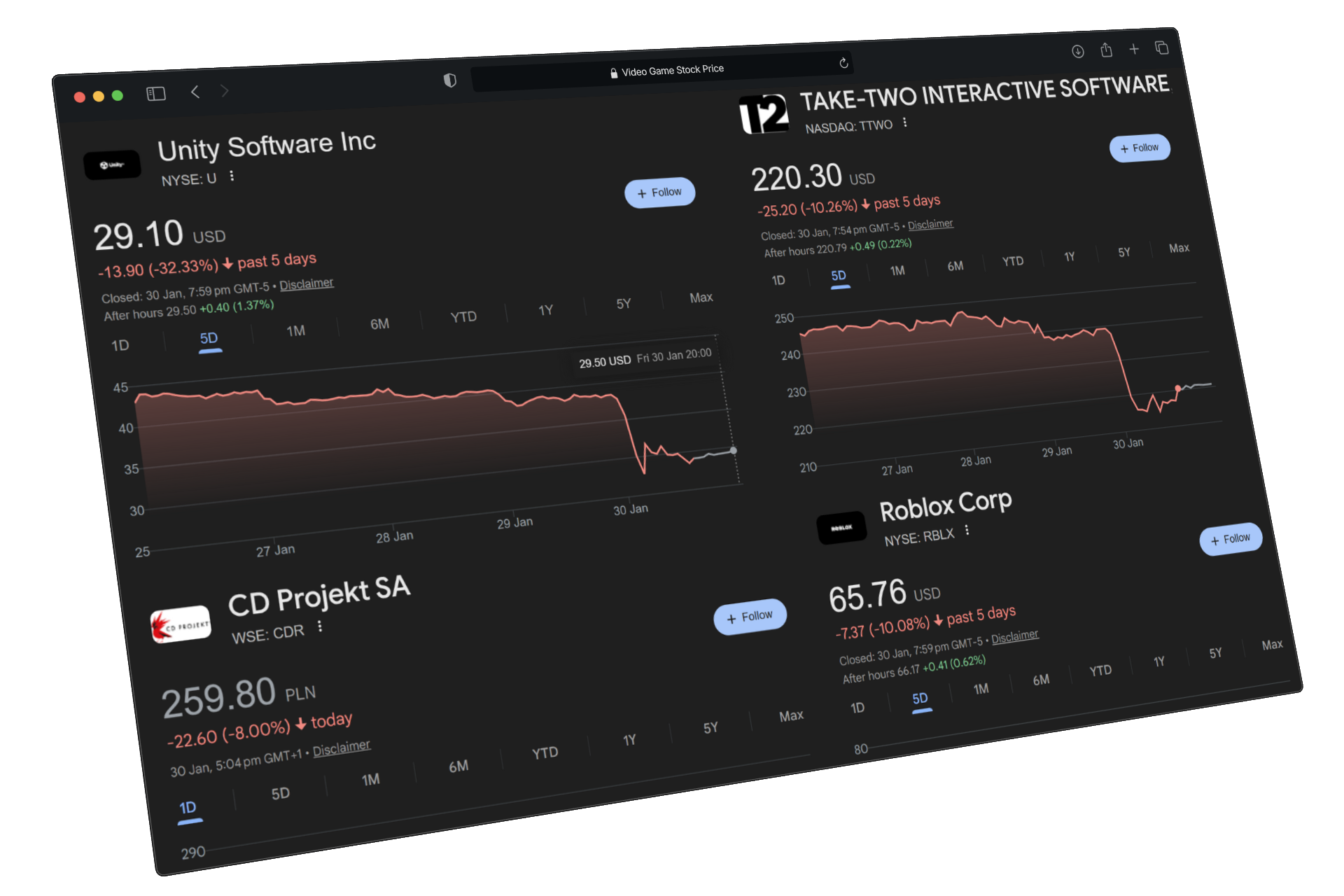
Yesterday, Google announced Project Genie, a new generative AI tool that can apparently create entire games from just prompts. It leverages the Genie 3 and Gemini models to generate a 60-second interactive world rather than a fully playable one. Despite this, many investors were scared out of their wits, imagining this as the future of game development, resulting in a massive stock sell-off that has sent the share prices of various video game companies plummeting.
The firms affected by this include Rockstar owner Take-Two Interactive, developer/distributors like CD Projekt Red and Nintendo, along with even Roblox — that one actually makes sense. Most of the games you find on the platform, including the infamous “Steal a Brainrot,” are not too far from AI slop, so it’s poetic that the product of a neural network is what hurt its stock.
Unity’s share price fell the most at 20%, since it’s a popular game engine. Generally speaking, that’s how most games operate: they use a software framework, such as Unity or Unreal Engine, which provides basic functionality like physics, rendering, input, and sound. Studios then build their vision on top of these, and some developers even have their own custom in-house solutions, such as Rockstar’s RAGE or Guerrilla’s Decima.
Welcome to the stock market: where the money’s made up and the rules don’t matter!
Always has been.
Remember when Elon had to buy Twitter?
Prior to that, he was manipulating the market through Twitter causing a lot of uncertainty.
Not always. It has been for longer than we’ve been alive, but stock originated as a way to fund merchant voyages - you paid a share of the costs and got a share of the proceeds (in merchandise or in the sale value of that merchandise) when the ship came in.
Literally the origin of the phrase “your ship has come in”.
Then people started speculating over the future value of and trading those shares while the ship was still at sea, then the concept got generalized beyond merchant voyages, etc and here we are where it’s more like the art market where things are worth whatever someone will pay and that value isn’t necessarily tied to anything concrete.
Yeah no I wouldn’t bet on the concrete market right now. Carbon taxes will likely continue to put a damper on those.
Better bet on the fictitious market, I head there’s some great sci-fi and general fantasy about to be released.
(Sorry, I just had to make that joke right now to vent)