
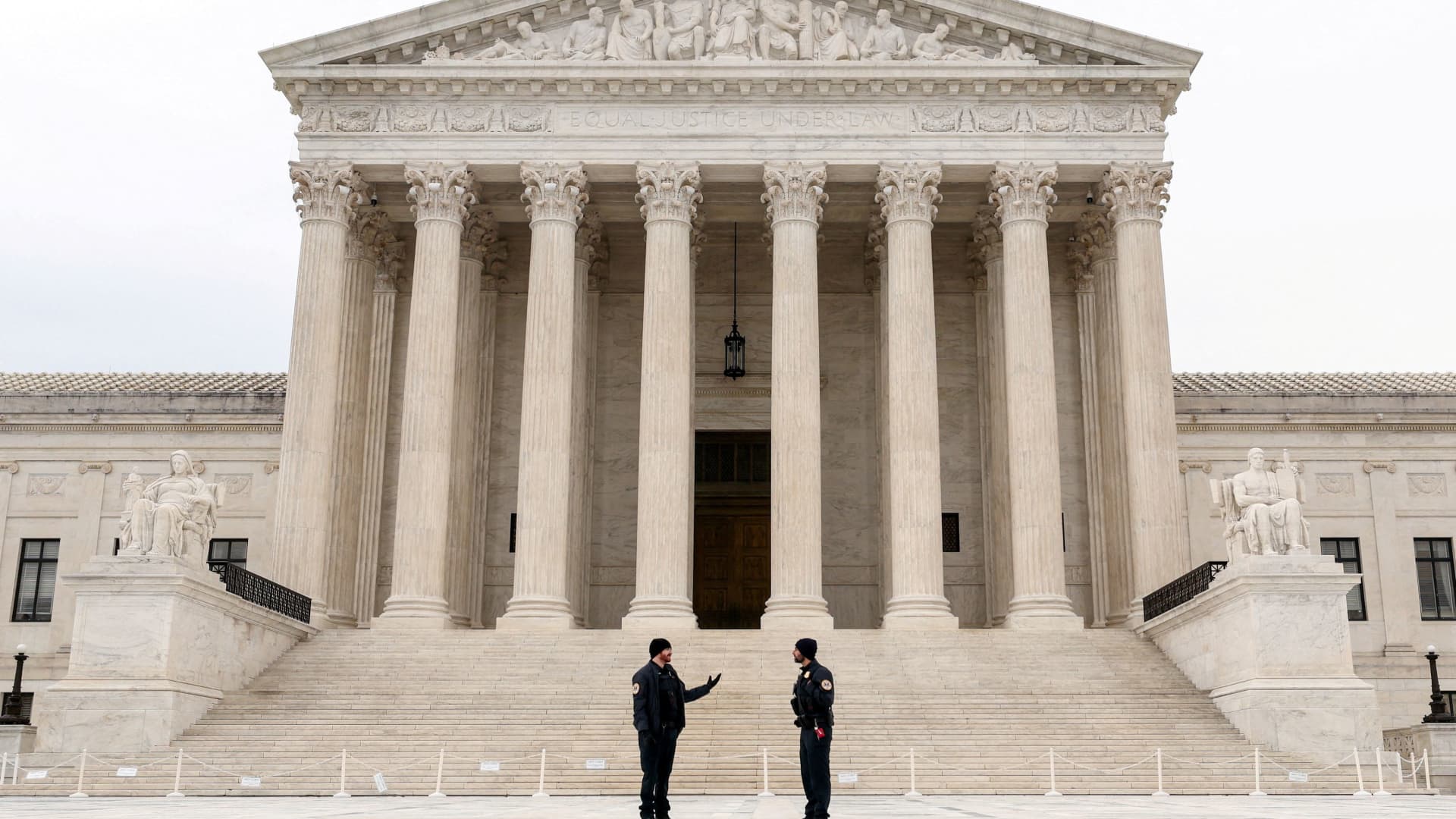
The U.S. Supreme Court declined on Monday to take up the issue of whether art generated by artificial intelligence can be copyrighted under U.S. law, turning away a case involving a computer scientist from Missouri who was denied a copyright for a piece of visual art made by his AI system.
Plaintiff Stephen Thaler had appealed to the justices after lower courts upheld a U.S. Copyright Office decision that the AI-crafted visual art at issue in the case was ineligible for copyright protection because it did not have a human creator.
Thaler, of St. Charles, Missouri, applied for a federal copyright registration in 2018 covering “A Recent Entrance to Paradise,” visual art he said his AI technology “DABUS” created. The image shows train tracks entering a portal, surrounded by what appears to be green and purple plant imagery.
The Copyright Office rejected his application in 2022, finding that creative works must have human authors to be eligible to receive a copyright. U.S. President Donald Trump’s administration had urged the Supreme Court not to hear Thaler’s appeal.
This is wildly wrong in so many ways.
Copyright is an intellectual property right, firmly grounded in property law doctrine–you are probably thinking of trademark, which is rooted in consumer protection law, or likeness rights which have their roots in privacy law.
The copyrightability of AI generated content gets to where the nexus of creativity happens. Effectively, image generators (modern ones–i actually don’t think DABUS is a diffusion model) are operated like a commissioned work. The user gives detailed instruction on par with what you might see in a commissioned work, and the creative event occurs when the “contractor” interprets that into the work. The copyright may be assigned or it may be licensed, in any case, the initial copyright holder is the contractor–or in our case, the model. Now, it is well established that only humans can have sua sponte property rights, including intellectual property right. Those can be assigned, licensed, etc., but they must first inher to a human and so an AI system literally has no copyright to assign, were it even able to engage in a contractual agreement to transfer said rights. As a result, no, there is no copyright in AI generated content and without a significant change in law there is unlikely to ever be any.
If he had sought to register the copyright under purely his own name, he would have been committing a fraud on the copyright office. This wasn’t explicitly established at the time of his suit, but it has been very explicitly the case now for over a year. When registering copyright you must declare any AI-generated components. Failure, or refusal, to do so constitutes a fraud on the office and such fraud is sanctionable up to revoking the copyright in the work in its entirety, even if the AI-gen component was only partial. This is really important to note with software copyright and the kind of litigation we’re likely to see wrt piracy in the future (i.e., defendant claims plaintiffs did not declare vibe coded components and thus committed a fraud on the office and should be sanctioned with full revocation of the right as a signal to other would-be claimants).
First of all, “Intellectual property[sic]” is a not a thing. There are copyrights, patents, trademarks, and trade secrets, but they are all significantly different from each other. Trying to lump them together under a single term is disingenuous at best, and using the word “property” in that term is biased loaded language.
Second, copyright cannot be a property right because ideas cannot be property. In fact, ideas are essentially the opposite of property, as Thomas Jefferson once pointed out:
What copyright actually is, is a temporary monopoly granted at the whim of Congress. It’s a license, not a right.