

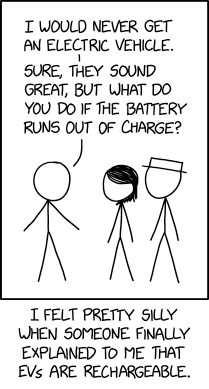
Title text:
Now that I’ve finally gotten an electric vehicle, I’m never going back to an acoustic one.
Transcript:
Transcript will show once it’s been added to explainxkcd.com
Source: https://xkcd.com/3214/
Title text:
Now that I’ve finally gotten an electric vehicle, I’m never going back to an acoustic one.
Transcript:
Transcript will show once it’s been added to explainxkcd.com
Source: https://xkcd.com/3214/
So, I’m going off of talking to mechanics and a lot of YouTube. But theres a few ways to slice it.
Most batteries aren’t experiencing total failures, which was more common on your electric cars of 15+ years ago (think Nissan leaf). But they lose capacity as they are used. 25% after 5 years is common. After 10 years it could be 50%. An EV advertised with 300 miles of range only really gets 250 from a full charge when it’s really cold out, by the time it’s a 10 year old car that could be anywhere from 90-140 miles depending on how the battery is holding up. And it still takes just as long to charge to 100%.
When a car loses this much performance, most people would say it “needs” a new battery. Not really sure how long cars manufactured 2020 and later are going to last before a complete failure on average, it might be 15-20 years. But even after the first couple years they are losing performance.
This is why EVs fetch extremely low prices used, and a lot of people recommend leasing rather than buying them. Because you can’t make or fix a battery at home, and the price of a new battery is $10k-$20k on a car that, probably, is starting to get other issues and has little or no service availability (since most owners are junking them).
So currently, a $30k Corolla is going to be worth far more 5 years after purchase than an $80k whatever EV you care to name.