No, the cat is one or the other. Radioactive half-life is the point at which there is a 50/50 chance that any single isotope had decayed, and we usually work around that in classical systems by using large sample sizes (a pile of isotopes, it’s easy to see that half of it would have decayed). But for one single isotope we aren’t observing (or the cat), we need to look at it in terms of probabilities until we observe it


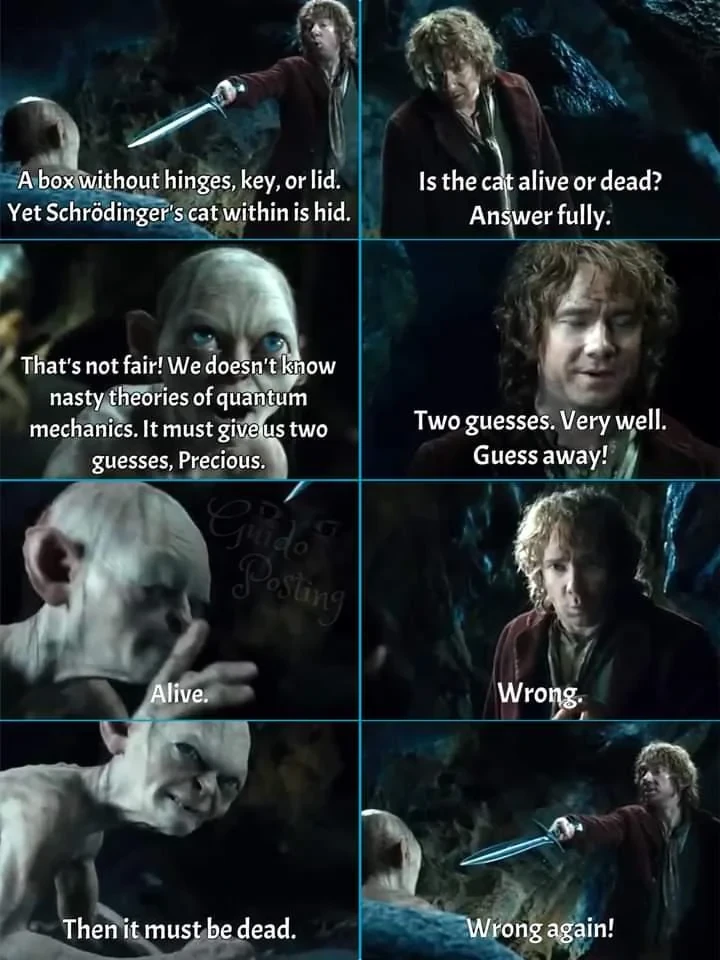
Shouldn’t they both be right
Luckily, Bilbo remembered to add “Answer fully”
Alive and death at the same time. It’s more like asking if the coin is heads or tails when the coin is still spinning.
No, the cat is one or the other. Radioactive half-life is the point at which there is a 50/50 chance that any single isotope had decayed, and we usually work around that in classical systems by using large sample sizes (a pile of isotopes, it’s easy to see that half of it would have decayed). But for one single isotope we aren’t observing (or the cat), we need to look at it in terms of probabilities until we observe it
Not if they are both wrong.