

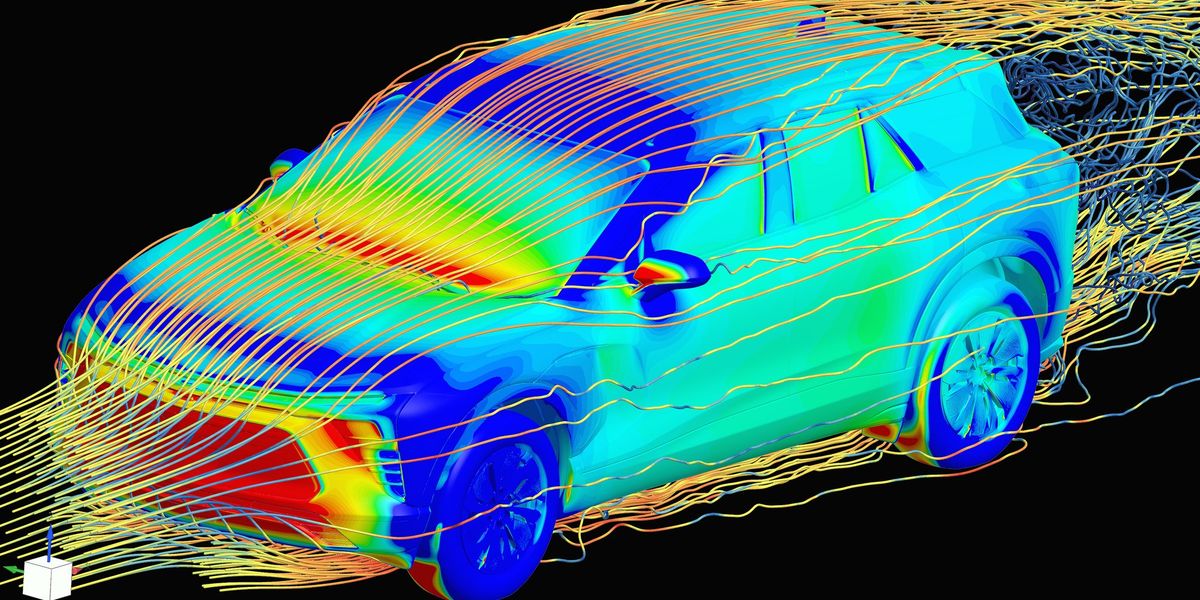
…Previously, a creative design engineer would develop a 3D model of a new car concept. This model would be sent to aerodynamics specialists, who would run physics simulations to determine the coefficient of drag of the proposed car—an important metric for energy efficiency of the vehicle. This simulation phase would take about two weeks, and the aerodynamics engineer would then report the drag coefficient back to the creative designer, possibly with suggested modifications.
Now, GM has trained an in-house large physics model on those simulation results. The AI takes in a 3D car model and outputs a coefficient of drag in a matter of minutes. “We have experts in the aerodynamics and the creative studio now who can sit together and iterate instantly to make decisions [about] our future products,” says Rene Strauss, director of virtual integration engineering at GM…
“What we’re seeing is that actually, these tools are empowering the engineers to be much more efficient,” Tschammer says. “Before, these engineers would spend a lot of time on low added value tasks, whereas now these manual tasks from the past can be automated using these AI models, and the engineers can focus on taking the design decisions at the end of the day. We still need engineers more than ever.”
Yah, I have some vague experience in the space and, without getting into things covered by NDAs, I guess I can say…
First, The popular media talks about the classic style of physics solvers as these magical black boxes but my experience is that they are sufficiently unreliable that I would never trust my life solely to the answers of a solver. They do provide very valuable feedback for refining a design without an endless hardware-rich cycle of destructive testing. Thus, I think that a large physics model is probably going to be the same sort of useful tool.
Second, while the CAE engineers can be very very protective over the time they spend on the two week cycle the article talks about, it’s fucking drudge work and a waste of a good mind. At the same time, the article does not really talk about some of the nitty gritty details. Aerodynamics is a great place to start because there’s less setup but the coefficient of drag is only one problem that needs to be considered.
Third, the good engineers can “see” things intuitively because things do operate with a pattern. Vorticies from protruding features… stress fractures from square holes in a beam… etc. This does feel like an area where spicy autocorrect can spicy autocorrect you to a useful answer.
Finally, cycle time for real world engineers is just like the cycle time for software engineers. Nobody wants to go back to the world where programmers submitted a deck of cards and got the printout back a week later.
The only real risk here is that somebody gets high on their own supply and decides that a large physics model is actually predictive and we don’t need the same set of actual physical tests that validate the models.
I don’t know what specific technology they’re using, but remember that not all AL/ML implementations are LLMs.
Yeah, I was referring to spicy autocorrect in the more general sense of something that uses a faster statistical model to replace a slower theoretically derived exhaustive calculation.