millia pasuum, literally “1,000 paces,” was a common unit of measure in the empire, and the basis of various modern miles. It was slightly shorter than the modern statute mile.
Interesting. Never realised that “mile” just means “thousand” (though it is kinda obvious in retrospect). And since the modern mile is 1760 yards, a kilometre is more of a mile than the actual mile.
Yeah, assuming that a yard is meant to approximate the stride of an adult human, who’s the Goliath-sized motherfucker with the 5’ 3" stride who took a thousand steps and called that a mile?
Edit: Okay, I checked.
The furlong (meaning furrow length) was the distance a team of oxen could plough without resting. This was standardised to be exactly 40 rods or 10 chains.
An English mile is defined as 8 furlongs, 8 presumably being chosen because it divides by 2 and 4. What a cockamamie system of measurement.
Edit Again: Okay, I checked again.
The modern English word mile derives from Middle English myle and Old English mīl, which was cognate with all other Germanic terms for miles. These derived from the nominal ellipsis form of mīlle passus ‘mile’ or mīlia passuum ‘miles’, the Roman mile of one thousand paces.
A pace is a unit of length consisting either of one normal walking step, or of a double step, returning to the same foot.
Far be it from me to defend the imperial system- I love and daily work in metric, but you realize nearly all ancient measurement systems are created around commonplace physical measures (body parts, strides, etc.) and simple multiples thereof to make their use easy, yeah?
We’ve got a lot of tools at our disposal now to both standardize and make working with a decimal system a lot more doable than before.


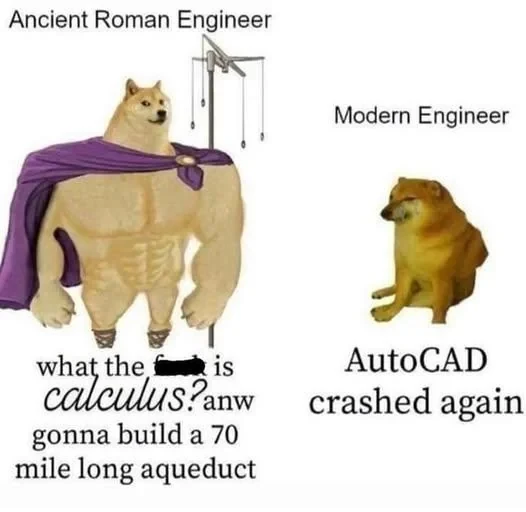
Roman engineers most probably never heard about miles too.
millia pasuum, literally “1,000 paces,” was a common unit of measure in the empire, and the basis of various modern miles. It was slightly shorter than the modern statute mile.
Interesting. Never realised that “mile” just means “thousand” (though it is kinda obvious in retrospect). And since the modern mile is 1760 yards, a kilometre is more of a mile than the actual mile.
Yeah, assuming that a yard is meant to approximate the stride of an adult human, who’s the Goliath-sized motherfucker with the 5’ 3" stride who took a thousand steps and called that a mile?
Edit: Okay, I checked.
An English mile is defined as 8 furlongs, 8 presumably being chosen because it divides by 2 and 4. What a cockamamie system of measurement.
Edit Again: Okay, I checked again.
This is all still very silly.
Far be it from me to defend the imperial system- I love and daily work in metric, but you realize nearly all ancient measurement systems are created around commonplace physical measures (body parts, strides, etc.) and simple multiples thereof to make their use easy, yeah?
We’ve got a lot of tools at our disposal now to both standardize and make working with a decimal system a lot more doable than before.