
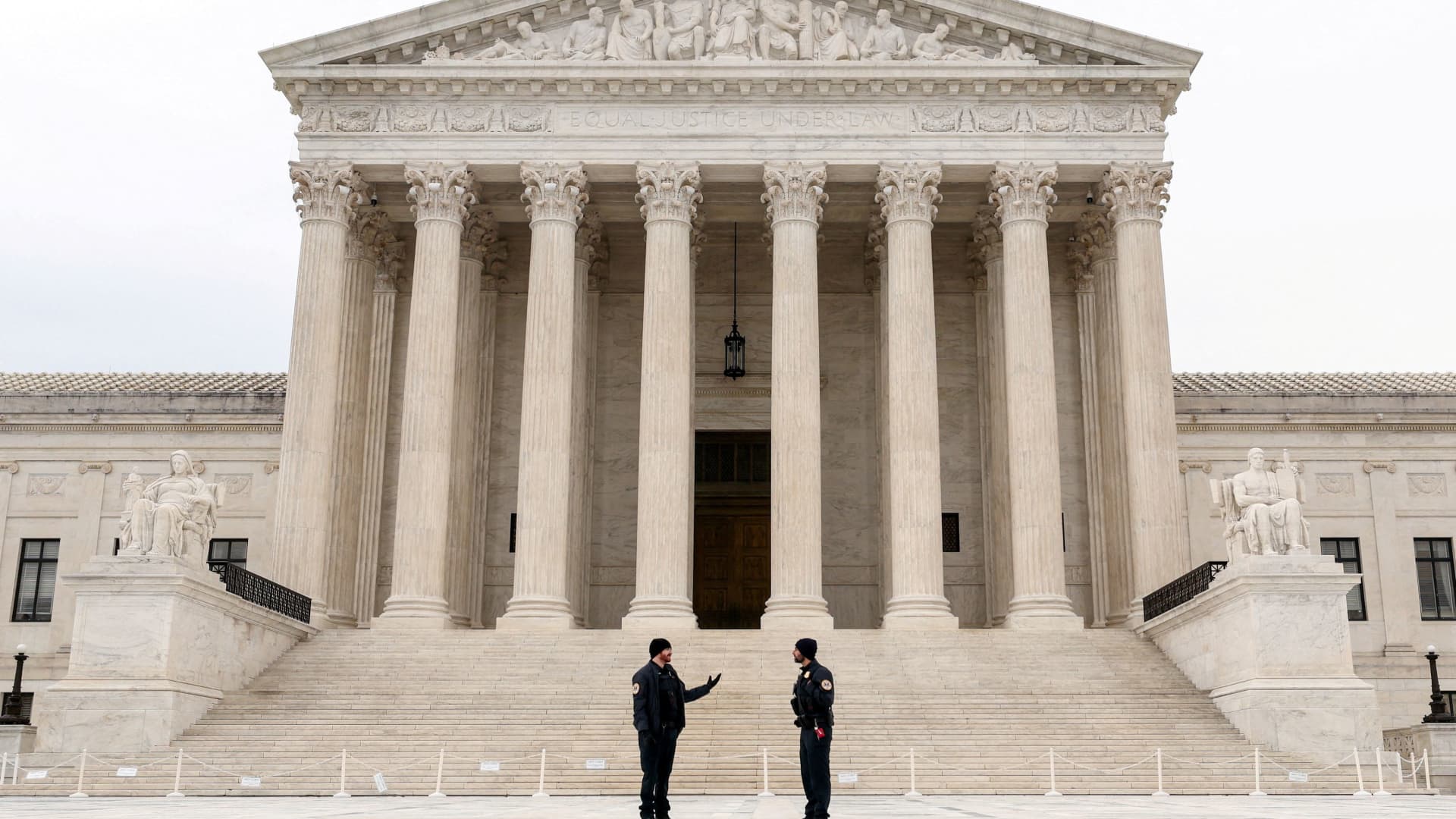
The U.S. Supreme Court declined on Monday to take up the issue of whether art generated by artificial intelligence can be copyrighted under U.S. law, turning away a case involving a computer scientist from Missouri who was denied a copyright for a piece of visual art made by his AI system.
Plaintiff Stephen Thaler had appealed to the justices after lower courts upheld a U.S. Copyright Office decision that the AI-crafted visual art at issue in the case was ineligible for copyright protection because it did not have a human creator.
Thaler, of St. Charles, Missouri, applied for a federal copyright registration in 2018 covering “A Recent Entrance to Paradise,” visual art he said his AI technology “DABUS” created. The image shows train tracks entering a portal, surrounded by what appears to be green and purple plant imagery.
The Copyright Office rejected his application in 2022, finding that creative works must have human authors to be eligible to receive a copyright. U.S. President Donald Trump’s administration had urged the Supreme Court not to hear Thaler’s appeal.
Gonna be fun times in courts as anyone can claim something was generated by AI even if an artist claims they created it.
I wonder if this will end up limited to art or can be expanded to other copyrighted works.
It’s not generally difficult at all for an artist to prove that they are the original creator of a certain piece. My photography for example is available for anyone for free and in high resolution but I’m the only one with the full resolution pictures and RAW files. So much data is lost when a picture is compressed into .jpg format.
Seems impossible to me but I’m not an artist - I write code as a hobby and see no way to definitively prove I wrote any code that an AI could also produce. Is there any aspect of art creation that an AI cannot replicate?
You don’t have drafts or anything that can show the history of development? I write as a hobby and I have tons of drafts that show the development of my stories over time. If somebody tried to claim my works were AI, I could easily dispute that.
What if the drafts were created using AI too?
Code is often in a source control system of some sort, which tracks changes to the code (who changed it, when it was changed, and a description of what was changed). It’s similar to having a lot of drafts.
I don’t think that could prove that a human wrote it, though.
I think in cases like this, the author could prove they created the code/story/art/whatever by having a deep understanding of the material. That’s how Michael Jackson defended against lawsuits saying he copied someone else’s song - he described his songwriting process and could hum/beatbox every instrument in the track.
How you gonna fake years worth of hand written notes, dated drafts, and revision history?
I don’t know how to write code myself, but intuitively it seems a little different in this case.
When it comes to photography, I can show the original unedited RAW file with full resolution and full metadata and everyone else just has a lower-resolution JPG. The same thing applies to most digital art.
Can you, though? What if you didn’t save it?
This is how you get a reputation as being a troll, FaceDeer
Says the guy who follows me around and dredges through months of my Reddit history looking for vaguely relevant comments to try to play “gotcha” with.
You could just block me, you know.
I wonder what percentage has to be created by a human to be eligible for copyright. For example, if someone generates an AI image and then changes a few pixels, is that human-created? What if they over-paint 30% of the image? 50%? What if someone creates something in Photoshop from scratch, but they use Photoshop’s in-built AI driven tools to enhance it?
Either anything that uses AI in any capacity is uncopyrightable, or there has to be a line somewhere, so… Where is it?
If the final product isnt the raw output from my understanding. The current laws are there mostly to stop the whole thing from turning into copyright mills.
Instead of considering if the whole work is now copyrightable, consider parts of the work made by generative AI are not and the human parts are (if they reach the minimum line of creativity). Sure there’s other helpful tools that do some of the work but unless they’re substituting the creativity then they need not apply.
It goes both ways. If the artist has to do 30% of the work, what about collages? Do we have to count the square millimeters of each cut and paste item to ensure they are above the threshold?
What if it’s a collage of AI generated art pieces? Technically the artist did the same amount of work as someone making a collage of human-created things.
Easiest should be all digital art is not copyrightable as it was created with software that did most of the work and the “artist” could not have produced it without that software. But that would invalidate almost all Hollywood movies from the last 30 years lol.
I mean, you could make the same argument for paint brushes for traditional art. Or pencils. There’s a really big difference between someone using a tablet and an Undo hotkey to draw something digitally vs. someone making something with AI. One of those clearly requires a ton of skill; one does not require any.
I said easiest, I didn’t say that’s the way it should be.
This is a really weird idea of what making digital art actually involves. Drawing on a screen with a stylus isn’t somehow not art made by a person because it’s digital instead of on paper. Even if you use a mouse to make pixel art or modify 3D models, that’s still human artistic decision making involved. Non-AI digital artwork doesn’t involve just pressing a button and getting art.