

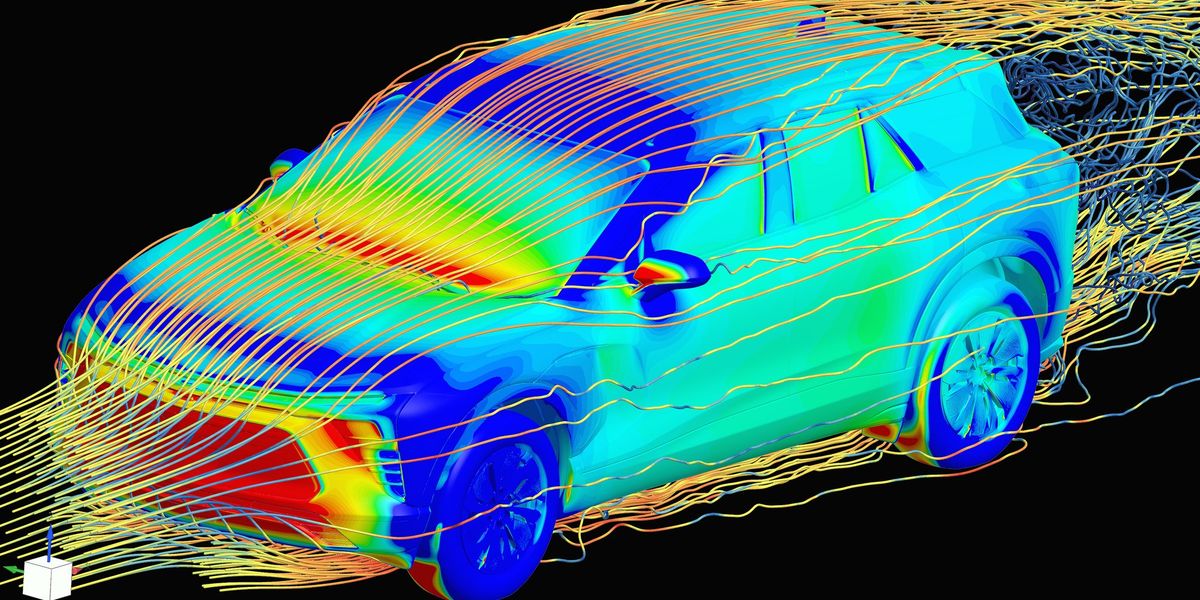
…Previously, a creative design engineer would develop a 3D model of a new car concept. This model would be sent to aerodynamics specialists, who would run physics simulations to determine the coefficient of drag of the proposed car—an important metric for energy efficiency of the vehicle. This simulation phase would take about two weeks, and the aerodynamics engineer would then report the drag coefficient back to the creative designer, possibly with suggested modifications.
Now, GM has trained an in-house large physics model on those simulation results. The AI takes in a 3D car model and outputs a coefficient of drag in a matter of minutes. “We have experts in the aerodynamics and the creative studio now who can sit together and iterate instantly to make decisions [about] our future products,” says Rene Strauss, director of virtual integration engineering at GM…
“What we’re seeing is that actually, these tools are empowering the engineers to be much more efficient,” Tschammer says. “Before, these engineers would spend a lot of time on low added value tasks, whereas now these manual tasks from the past can be automated using these AI models, and the engineers can focus on taking the design decisions at the end of the day. We still need engineers more than ever.”
I once worked tech support for people who ran physics simulations. They said that sometimes they had to rerun the simulations if they didn’t come back accurately. I asked how they could tell if they were accurate.
They said it was based on whether it felt right. I still hate that response, but I guess I can’t come up with a better idea, other than doing whatever they’re testing in real life.
Those kinds of simulations are inherently chaotic, tiny changes to the initial conditions can have wildly different outcomes sometimes to the point of being nonsensical. Also, since they’re simulating a limited volume the boundary conditions can cause weird artifacts in some cases.
If you run a simulation of air over an aircraft wing and the end result is a mess of turbulence instead of smooth flow then you can assume that simulation was acting weird and not that your wing design is suddenly breaking the rule of physics. When the simulation breaks it usually does so in ways that are obvious due to previous testing with physical models.
That’s … Basically what they said.
No, they said “it felt right” which is incomprehensible to anyone that doesn’t have any experience with how a CFD results generally looks like.
I don’t have any experience with “CFD results” but the two sound similar to me. The ellipsis might have made it seem sarcastic, but that wasn’t my intent.
CFD = Computational Fluid Dynamics.
It is kind of what they said, you’re right. I was more pointing how how it could be that they could ‘sense the vibes’ of a CFD result to determine if it is accurate or if the model decided to do something weird. Since it’s a chaotic process and also an artificial one, the starting conditions can yield results that are impossible/not based on reality.
If you look at enough of them you start to notice the kinds of things that go wrong. They would also have a pretty good idea about how their design should perform and if the simulation shows different they’d first want to troubleshoot the simulation before attempting to re-design whatever system they’re creating.
Maybe you’re my old co-worker.
Regardless, I appreciate the detail! Thank you for elaborating.
I have friends everywhere.
I don’t know how to respond to that.