

1·
1 day agoAlso doesn’t display anything without javascript
Also doesn’t display anything without javascript
I personally use tankie.tube.
And I’m pretty sure there are also jellyfish that live in symbyosis with algae that they carry along with them which photosynthesize, creating sugars for the jellyfish.

That’s weird, because it also has 2 downvotes for me at the moment (which means it can’t be some weird federation issue), but assuming that you originally saw 2 downvotes before I came along, then something something can’t be right because I am one of the two downvoters and I only saw the comment some hours after your comment in this thread (judging from the timestamp of my comment) (or maybe I visited the post once, then came back to leave a comment?).
Is it still -2 for you though?
It’s two downvotes (at least on lemmy.ml at this point in time). Is it hard to imagine that 2 out of 16 people could dislike seeing someone say that anything that doesn’t fit their narrative is the result of bots?
What makes you think it isn’t just real people?
I don’t think ð was pronounced exactly the same way as thSeems like I was thinking of other languages where they were/are pronounced differently.

Linux is the kernel, not the OS. RedStar uses Linux as the kernel.
Btw, what is a non-local RSS reader? I have come across multiple that RSS readers that advertise being “self-hosted” and I’m confused about that since in my mind RSS readers are simply clients that periodically query different servers for an .rss file, so I’m confused about where there is anything to host besides the host of the .rss feed.
Yeah I also never reached the end, though I imagine if playing multiplayer, with enough players and time, that then at some point there won’t be any untouched land.
I like my toots.
That code was C++ or something like that. Not GDScript.
I tested this on Godot 4.2.1. You can write identifiers using a different writing system other than latin and you are allowed to have emojis in strings, but you aren’t allowed to use emojis in identifiers.
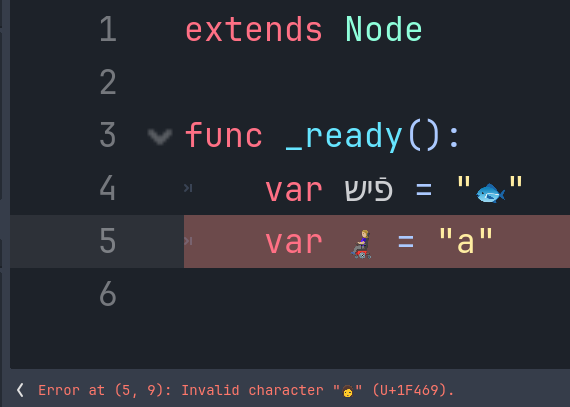
I think they exclude some unicode characters from being use in identifiers. At least last I tried it wouldn’t allow me to use an emoji as a variable name.
I didn’t know who she was, so I just assumed it was true and that she was just another celebrity sponsored by a VPN company.
I’m using both.
I installed NoScript just a few days ago, because I’m forced to use a really weak computer that struggles to even browse the modern web. I feel like NoScript improved it a lot, and while quite a few websites broke (including lemmy) (but most will still display the content), I just set the ones that I need working to trusted, but the performance is still good (I should note I’m also using it in conjunction with an automatic tab discarter).
I however also don’t directly use Google. Both SearX and Yandex don’t need javascript, so I’m unaffected by these news, despite being a bit mad about it as a reflection of the direction the web is going as a whole.

The hover-over text says “Disclaimer: I have not actually tried the beta yet. I hear it’s quite pleasant and hardly Hitler-y at all.”







What kind of data does listenbrainz and last.fm store and what are they used for?