I take my shitposts very seriously.

  • 14 Posts
  • 1.11K Comments
Joined 2 年前
cake
Cake day: 2023年6月24日

help-circle
  • (I’m not a lawyer, this comment should not be viewed as a credible source)

    They probably mean professionals that are hired by clients on a retainer agreement as opposed to working for an employer on a permanent or semi-permanent basis. Legal advice, legal representation, financial advice, personal assistants, individual contractors, and so on.

    One could make the argument that since the retainer is not an employment contract, and the retained professional is not one of many employees (instead usually individuals or small teams), then collective bargaining doesn’t make sense. The difference is that the retainer agreement is much more specific and favors the person whose services are retained, compared to employment contracts and labour laws in the USA. It’s also a legally binding contract and the client can be taken to court if it is breached (e.g. by withholding payment).

    On the other hand, if those people are also employed by a company (e.g. a non-partner associate in a law firm) or employ other people in turn, then those people can (and should) also benefit from collective bargaining.


  • The problem is that syncing between devices is not implemented in KeePass itself but through an external tool (Nextcloud, Syncthing, or whatever else). The sync client will only see the ciphertext and won’t be able to tell which records have been changed, only that two different binary files have a common ancestor and are in conflict.

    The most obvious solution is to lock and close the database when it’s not in use (which is a good practice from a security perspective too), and to sync immediately when it is changed.


  • losing integration because “containerized”

    Bollocks. I’ve seen that many times with Flatpak (can’t speak for Snap), and every single time it was either because the packager failed to set up permissions or because the user messed with permissions that the application needed. Break off the tip of a screwdriver and it will no longer function as a screwdriver.

    And I know you’re talking out of your ass because AppImage isn’t even sandboxed.

    taking GBs of space

    That part is true and accurate, and for a very good reason: dependency pinning. System packages can break if they don’t have the correct versions of shared libraries. If a package requires a very old version of a library, and doesn’t link it statically or supply it with the package, it can misbehave, have missing features, or refuse to even start. Flatpak (and probably Snap too, can’t speak for it) solves that by letting the packager specify (pin) the exact version of a dependency. If five separate packages require five different versions of the GNOME application framework, then they will download five separate packages of the correct version. AppImage solves it by being monolithic: everything is packaged together into a single executable.


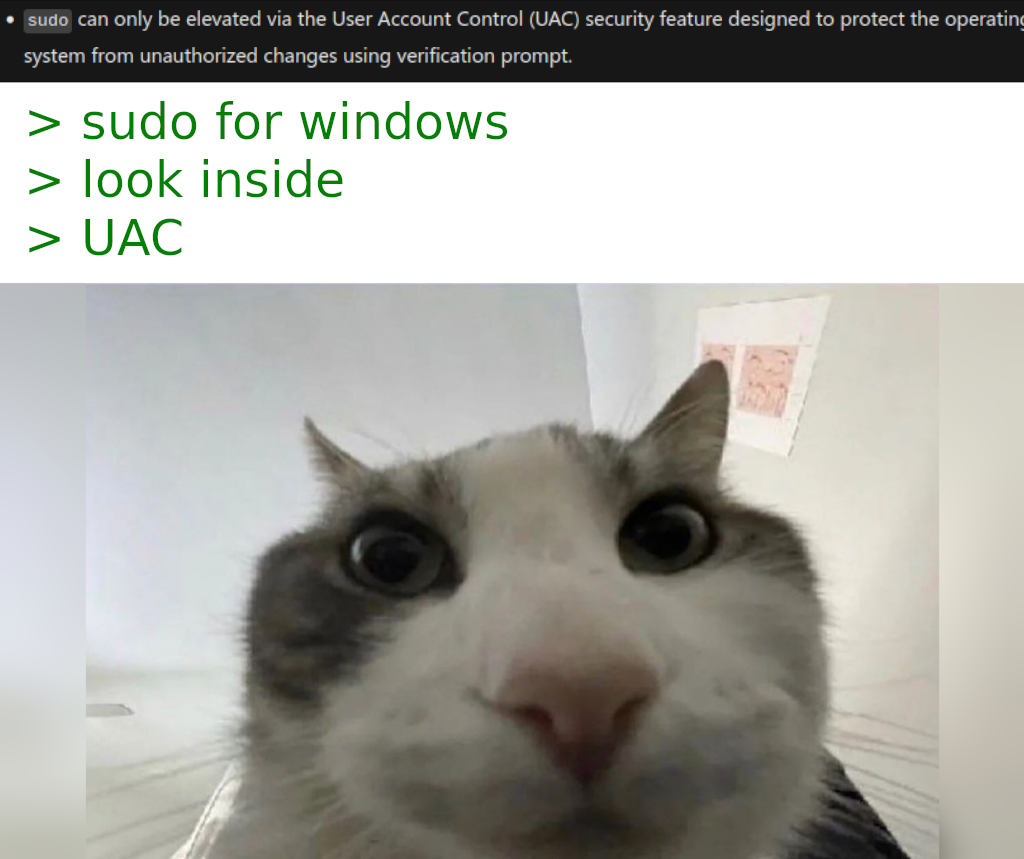
  • Uh… kinda? Powershell has many POSIX aliases to cmdlets (equivalent to shell built-ins) of allegedly the same functionality. rmdir and rm are both aliases of Remove-Item, ls is Get-ChildItem, cd is Set-Location, cat is Get-Content, and so on.

    Of particular note is curl. Windows supplies the real CURL executable (System32/curl.exe), but in a Powershell 5 session, which is still the default on Windows 11 25H2, the curl alias shadows it. curl is an alias of the Invoke-WebRequest cmdlet, which is functionally a headless front-end for Internet Explorer unless the -UseBasicParsing switch is specified. But since IE is dead, if -UseBasicParsing is not specified, the cmdlet will always throw an error. Fucking genius, Microsoft.


  • My opinion is the exact opposite. Narrative games, even action shooters, need to have high action and low action parts in balance. If high action segments are excessive, it can lead to combat fatigue. If low action parts are excessive, the player gets bored and the pacing dies.

    Half-Life 2 E1, the “Low Lives” chapter, has probably the most stressful combat in the game because the player has to balance so many things. Shooting the zombies attacking Gordon versus helping Alyx fight. Helping Alyx versus keeping the flashlight charged. Firearms versus explosive props. All of that in oppressive darkness. Combat fatigue sets in. The short puzzle segments, even as simple as crawling through a vent to flip a switch, are opportunities to take a breath, absorb the environment, and prepare for the next segment – especially at the end of that particular chapter, when the player escapes the zombies and has a chance to wind down.

    At the same time, puzzles, by their slower nature, are excellent for delivering narrative and player training, and to let the player absorb the atmosphere. Alyx’s first encounter with the stalkers in “Undue Alarm” wouldn’t have had the same emotional impact if the player could just pop them in the head and move on.

    In contrast, most of “Highway 17” is just a prolonged vehicle-based puzzle. By the time the player reaches the large railway bridge, they might be sick of driving. I know I was. It’s a relief to finally engage in some platforming and long-range combat while traversing the bridge.

    So what are the narrative values of my two examples? The cinderblock seesaw in “Route Kanal” is just player training. A show, don’t tell method to let the player know that physics puzzles will be a factor. It’s also a short break after the on-foot chase, before the encounter with the hunter chopper. In “Water Hazard”, the contraptions serve a larger narrative purpose: they’re the tools of the rebels’ refugee evacuation effort. The player utilizes them like one of the refugees would have.