

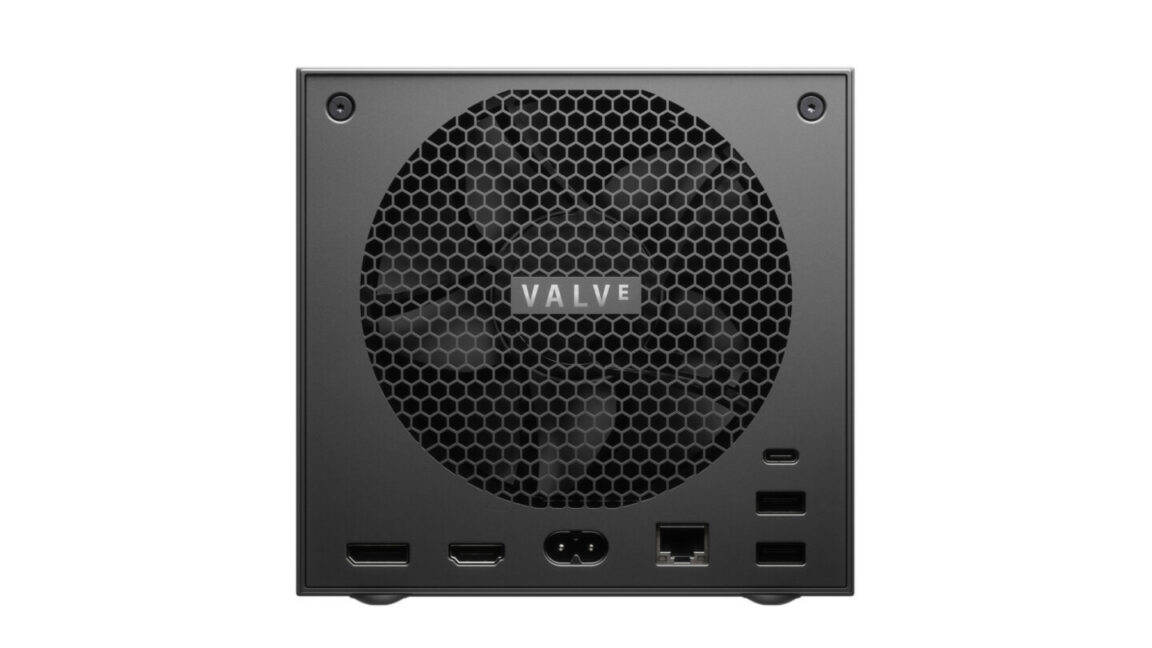
The TL;DR is that the organization that controls the HDMI standard won’t allow any open source implementation of HDMI 2.1.
So the hardware is fully capable of it, but they’ll get in trouble if them officially implement it.
Instead it’s officially HDMI 2 (which maxes out at 4k @ 60Hz), but through a technique called chroma sub-sampling they’ve been able to raise that up to 4k @ 120Hz.
However there are some minor reductions in picture quality because of this, and the whole thing would be much easier if the HDMI forum would be more consumer friendly.
In the meantime, the Steam Machine also has display port as a completely issue free display option.
USB-C probably cannot replace either, because the unmating force is too light. A typical HDMI or DisplayPort cable is much thicker, longer and hence heavier than a typical USB-C cable (even those specced to carry high bandwidth, like a thunderbolt cable) because they need better shielding to carry high bandwidth signals long distances - it’s not unusual to need to route HDMI several metres (but USB-C cables that long are unusual because of the different purposes)
For TVs and such it’s useful to have the inputs connect vertically, so that they don’t stick out the back of the device and cause problems pushing it against a wall. Then the weight of the end of the cable is going to be trying to pull the connector out of the TV. DisplayPort connectors can have a latch to deal with this.
Of course, there a ways around this: a new connector, for example. But it does mean that you can’t just leverage the existing pool of USB-C connectors and cables to make this ubiquitous.
To mention, this is also a problem with HDMI (but not DP).
But just have the usb-c insert top down instead of bottom up, include room for a small loop and cable retention to ensure slack doesnt put pressure on the port. This easily allows for fixed connections with usb-c.
There are also side-screw locking connectors for usb-c. With HDMI, a top-screw option was made for more fixed install scenarios. That design is ugly af and uses a massive amount more room than the usb-c screw lock approach.
Oh, screw lock as in like some PC tower cables? Yes, that would be really nice, I wouldn’t mind that for a phone.
Exactly that.
Its mostly common on commercial devices still, but it is defined.
https://www.usb.org/document-library/usb-type-cr-locking-connector-specification
As an example:
https://www.startech.com/en-us/cables/usb31ccslkv1m
Though again, a lot of this could be mitigated with a loop, strain relief, and inserting from above into a port rather than letting gravity pull it down. But it would be nice to see side screw locks be more common with usb-c.
That usb-c connector with side screw locks looks like a future I want to live in.
It’s futuristic, but it’s open and not corporate. It’s miniaturized and sleek, yet still mechanically rugged.
Could it be done with a tiny magnet?
Anything important enough to be secured you probably dont want to involve a magnet for.
A good USB c cable and port can hold quite a bit of weight, I’ve easily picked my phone up by it as long as you don’t make any jerking movements. That’s a lot more weight than a few feet of even a very heavily shielded cable.
Just duck tape the usb cable to the back of the TV
Solvable by moving the locking mechanism out of the port and making one that you can retrofit to any cable
The connectors on the back of the TV can be oriented horizontally (like parallel to the screen, not perpendicular), which at least changes the pull force to a torque force, which isn’t ideal but easier to hold on to.