their engineering was amazing, but to compensate for lack of modern maths, they build with a much larger margin of safety and strength.
that’s why some of those aqueducts last 2000 years.
no one wants to build infrastructure that lasts so long. we could build a bridge designed to last thousands of years, but it’ll cost way way more, and the budget isn’t unlimited.
I like the way someone described a similar retort:
Anyone can build a bridge that stays up and lasts a long time, but it takes a skilled engineer to build a bridge that just barely stays up a long time and minimizes costs and materials.
They were designed for that (usually), if you want a bridge to last multiple millenia you can design it for that. but it will probably add a couple zeroes at the end of the bill.
Despite the widespread use of slave labor in Roman society, unskilled slaves were overwhelmingly used for tasks that were either considered ‘demeaning’ (like domestic servants), did not require any real precision (like mill grinding and monocrop farm labor) or needed a constant application of labor (like mines). The Romans recognized that people work better when offered carrots rather than sticks - some slave who only barely cares if he lives or dies isn’t going to put much effort into aligning the brick with the mortar properly unless you watch him like a hawk - which is more labor you have to put in. Manual labor for construction is not a task that requires a doctorate, but it is a task where you have to do it right the first time, or you waste everyone’s labor and effort.
Construction, furthermore, is only intermittent work in most places. If you own a bunch of slaves, you don’t stop paying for their food and shelter when they aren’t working - if you want them to be profitable, you’ll have to find other work for them to do the rest of the year. And at that point, it’s probably not less profitable to just have them do that year-round instead. You could, potentially, have your slaves as a traveling construction crew, but travel is not only uncertain and expensive, but offers opportunities for unmotivated workers (like slaves) to simply… slip away, and choose to no longer be one of your workers. Even if you try to hunt them down. Even just transporting building materials from Point A to Point B includes a lot of very dangerous unsupervised time - perhaps something you’d trust a household slave with, but not one of the faceless slave numbers on your business ledger!
Funny enough, it would be more likely, if anyone was a slave on the job, that it would be potentially a few of the skilled positions. Skilled slaves were often given more trust and responsibilities precisely because they were offered more ‘carrot’ than ‘stick’ - payment, privileges, and the possibility of freedom for a decade or two of labor were on the table. Skilled slaves were thus less likely to run away - and unlike free wage laborers, especially skilled ones, wouldn’t (or rather, couldn’t) demand more pay at the prospect of being dragged from one of the empire to another - very handy if you’re a small construction firm going from place to place, and hiring local labor for most tasks!
but it’ll cost way way more, and the budget isn’t unlimited.
I wish things weren’t always so short-sighted by default. I mean sometimes things evolve so maybe it’s better to leave room for teardown and improvement or whatnot.
But it seems if you’re not thinking in “quarterlies”, infrastructure that’s built once and simply maintained should cost a lot less in the long run.
But then I guess the contractors would dry up if they didn’t have to come rebuild it a dozen times a decade. :p
I feel, for the hard to replace stuff an interstate bridge in a dense city for example, aiming for a three digit life span should be considered.
Just because it kinda sucks having to replace infrastructure like that. And the city is most likely still going to be there and need that infrastructure.


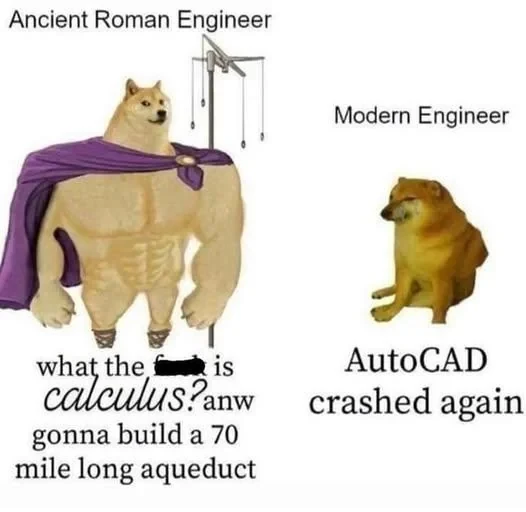
there’s a difference.
their engineering was amazing, but to compensate for lack of modern maths, they build with a much larger margin of safety and strength.
that’s why some of those aqueducts last 2000 years.
no one wants to build infrastructure that lasts so long. we could build a bridge designed to last thousands of years, but it’ll cost way way more, and the budget isn’t unlimited.
And even if we could, Autocad crashed again so I can’t
just use msPaint, more reliable
is that still the case in windows 11? if it is they’ll probably fix that soon by adding copilot to it 😅
that is your fault from updating from windowsXP
I like the way someone described a similar retort:
Anyone can build a bridge that stays up and lasts a long time, but it takes a skilled engineer to build a bridge that just barely stays up a long time and minimizes costs and materials.
100% not a joke, that is the point.
Also our bridges are subjected to the insane forces of truck freight transportation. Who know how long they would last otherwise.
They were designed for that (usually), if you want a bridge to last multiple millenia you can design it for that. but it will probably add a couple zeroes at the end of the bill.
Romans had the ‘advantage’ of slave labour,
Interestingly enough, construction wasn’t a usual avenue for applying slave labor in Ancient Rome.
really?
Did they paid professionals to do that? I understand masons, but not the actual putting a big brick on top of another
Wage labor, usually.
Despite the widespread use of slave labor in Roman society, unskilled slaves were overwhelmingly used for tasks that were either considered ‘demeaning’ (like domestic servants), did not require any real precision (like mill grinding and monocrop farm labor) or needed a constant application of labor (like mines). The Romans recognized that people work better when offered carrots rather than sticks - some slave who only barely cares if he lives or dies isn’t going to put much effort into aligning the brick with the mortar properly unless you watch him like a hawk - which is more labor you have to put in. Manual labor for construction is not a task that requires a doctorate, but it is a task where you have to do it right the first time, or you waste everyone’s labor and effort.
Construction, furthermore, is only intermittent work in most places. If you own a bunch of slaves, you don’t stop paying for their food and shelter when they aren’t working - if you want them to be profitable, you’ll have to find other work for them to do the rest of the year. And at that point, it’s probably not less profitable to just have them do that year-round instead. You could, potentially, have your slaves as a traveling construction crew, but travel is not only uncertain and expensive, but offers opportunities for unmotivated workers (like slaves) to simply… slip away, and choose to no longer be one of your workers. Even if you try to hunt them down. Even just transporting building materials from Point A to Point B includes a lot of very dangerous unsupervised time - perhaps something you’d trust a household slave with, but not one of the faceless slave numbers on your business ledger!
Funny enough, it would be more likely, if anyone was a slave on the job, that it would be potentially a few of the skilled positions. Skilled slaves were often given more trust and responsibilities precisely because they were offered more ‘carrot’ than ‘stick’ - payment, privileges, and the possibility of freedom for a decade or two of labor were on the table. Skilled slaves were thus less likely to run away - and unlike free wage laborers, especially skilled ones, wouldn’t (or rather, couldn’t) demand more pay at the prospect of being dragged from one of the empire to another - very handy if you’re a small construction firm going from place to place, and hiring local labor for most tasks!
like musical instruments, bridges are meant to be stressed. gotta drive over em with trucks or they’ll shoot off into space
It’s also worth pointing out those structures aren’t subjected to a lot of freeze thaw cycles, not to mention almost no salt.
I wish things weren’t always so short-sighted by default. I mean sometimes things evolve so maybe it’s better to leave room for teardown and improvement or whatnot.
But it seems if you’re not thinking in “quarterlies”, infrastructure that’s built once and simply maintained should cost a lot less in the long run.
But then I guess the contractors would dry up if they didn’t have to come rebuild it a dozen times a decade. :p
Yhea, it is better to build infrastructure that lasts, but 2000 years?
that is a bit overkill, and more of a vanity project for billionaires which is more of a cry for help (by help I mean guillotine)
I feel, for the hard to replace stuff an interstate bridge in a dense city for example, aiming for a three digit life span should be considered.
Just because it kinda sucks having to replace infrastructure like that. And the city is most likely still going to be there and need that infrastructure.
Golden gate is almost 90, empire State building also approaching a 100,
I think we can do that.