

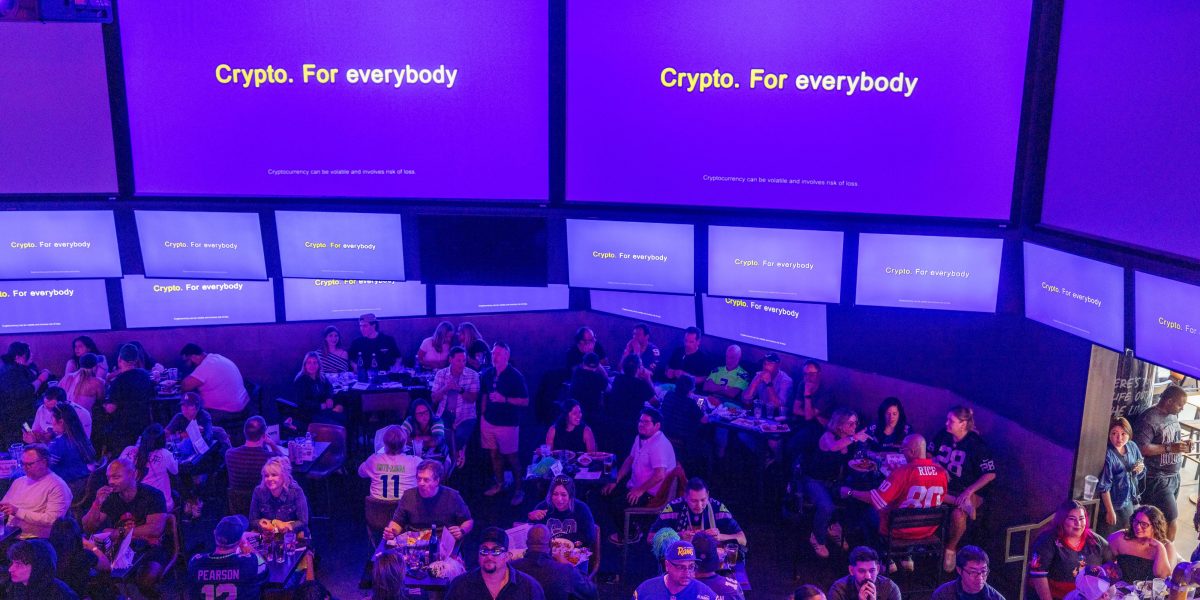
During the Super Bowl, Anthropic ran a dystopian AI ad about dystopian AI ads featuring an AI android physical trainer hawking insoles to a user who only asked for an ab workout. Not to be outdone, Amazon ran a commercial for its AI assistant Alexa+ in which Chris Hemsworth fretted over all the different ways AI might kill him, including severing his head and drowning him in his pool. Equally bleak, the telehealth company Hims & Hers ran an ad titled “RICH PEOPLE LIVE LONGER” in which oligarchs access such healthcare luxuries as facelifts, bespoke IVs, and “preventative care” to live longer than the rest of us. It was an anti-billionaire ad by a multibillion-dollar healthcare company.
Turn on the TV today, and you will drown in a sea of ads in which capitalists denounce capitalism. Think of the PNC Bank ads where parents sell their children’s naming rights a la sports stadiums for the money to raise them or the Robinhood ads where a white-haired older man, perhaps meant to evoke Bernie Sanders or Jeremy Corbyn, curses the “men of means with their silver spoons eating up the financial favors of the one percent” from the deck of a yacht.
After years of ingesting the mainstream discourse around surveillance capitalism, Occupy Wall Street, and democratic socialism, corporations are regurgitating and even surpassing the rhetoric of the modern left. Naturally, it’s all a winking sleight of hand meant to corral us back into engaging with the same capitalism they portray as a hellscape — but with new and improved privatized solutions. In another widely reviled Super Bowl ad, the video doorbell company Ring tells us that every year, 10 million family pets go missing, and by opting into a web of mass surveillance, the company has reunited “more than a dog a day” with their families.
Modern advertisers descend from those ad men of the 1960s who first perfected the art of channeling our angst with society writ large into buying more junk. As historian Thomas Frank wrote in his book “The Conquest of Cool,” midcentury advertisers constructed “a cultural perpetual motion machine in which disgust with the … everyday oppressions of consumer society could be enlisted to drive the ever-accelerating wheels of consumption.”
The machine has hummed on ever since, retrofitting capitalism’s reprimands into its rationales. It churns out commercials reframing the precariat’s pain not as the product of plutocracy but as the product of buying the wrong products. Advertisements pitch that the good life is to be secured by procuring high quality goods, by curating the right combination of AI assistants, locally crafted beer, paraben-free dryer sheets, Jimmy Dean breakfast biscuits, Capital One Venture X points, BetMGM spreads, Coinbase crypto wallets, on and on.
It’s lunacy. Buying Levi’s won’t give you deep pockets. Brand promises, like all promises, are made to be broken. As AI anxiety fueled fears of mass layoffs, Coca-Cola soothed American workers’ worries about “AI coming for everything” with a glossy 2025 Super Bowl ad, featuring Lauren London, where the gleaming actress flexed her dimples and told us everything would be all right. Ten months later, Coke automated its advertising with generative videos, replacing the actors they’d paid to soothe our worries about being replaced by AI with AI itself.
What feels different this time isn’t hypocrisy. Capitalism has always been happy to sell us our own anger back at retail. What feels different is that the ads no longer presume a shared reality at all.
Advertising once depended on ambient trust. Not belief, exactly, but a background assumption that words meant roughly what they said, that fear was proportional to risk, that reassurance implied some intention to follow through. That layer is gone. Now the ad doesn’t ask to be believed. It just asks to be noticed.
When companies openly dramatize the harms of the systems they profit from, they aren’t confessing. They’re signaling that truth has become optional. The message isn’t “we see the problem.” The message is “nothing means anything long enough to matter.” Anxiety becomes just another raw material, interchangeable with humor or nostalgia or menace.
This is where the information economy starts to eat itself. If every message arrives pre-saturated with irony, critique, and self-awareness, then no signal can rise above the din. Warnings, reassurances, satire, and sales pitches collapse into the same register. The audience isn’t persuaded or misled so much as numbed.
AI accelerates this collapse because it removes the last residue of intent. When the thing soothing your fear of replacement is itself replaceable by a cheaper, faster version, trust doesn’t break. It evaporates. There’s no betrayal because there’s no relationship left to betray.
And that erosion reaches even here. A reply like this would once have felt like an intervention, or at least a refusal. Now it lands as another object in the stream. Legible, maybe even accurate, but easily skimmed, quickly metabolized, and just as quickly forgotten. The critique doesn’t fail because it’s wrong. It fails because the conditions that once gave critique traction are gone.
At that point advertising stops functioning as communication and starts functioning as weather. It happens around us. We endure it. We don’t argue with it because there’s nothing there to argue with.
That feels new. And it feels brittle. Societies can survive a lot of lies. They don’t do well when meaning itself becomes non-durable.
(I write fiction and essays about witnessing systems as they fail quietly rather than spectacularly. If this kind of erosion, of trust, meaning, and shared signal, is something you’re thinking about too, my work lives here: https://tover153.substack.com/)
Thanks for the link. I was gonna ask if you were a writer, heh.
I agree. The tone of the ads this year felt almost like lampshading. Like if we acknowledge the problem, we’re wise to what the audience is feeling, but we’re not going to do a damn thing to address it. It’s just something that needs to be done to make the ad feel remotely relevant.
AI is scary, but don’t be afraid of our surveillance device because we acknowledged that AI is scary
AI will sell you ads. Anyway, you’re watching an ad for AI
Work sucks amirite? Why not let us unemploy you?
There’s a wealth gap. Spend money on our stuff.
And I’m not going to even link the He Gets Us ads.
Exactly. Lampshading is the right word for it.
Once acknowledging the problem becomes the whole move, relevance replaces responsibility. The ad doesn’t promise to fix anything. It just proves it knows the vibe. That awareness is treated as absolution.
“AI is scary, but trust our AI” “Work sucks, so automate yourself out of it” “There’s a wealth gap, here’s a checkout button”
None of it is persuasion anymore. It’s alignment theater. The point isn’t to convince you. It’s to make sure you don’t recoil.
And yeah, the He Gets Us ads are a whole separate category of grim. When even moral language is reduced to brand-safe tone, you’re not being spoken to. You’re being processed.
I’ve got a few essays in the drafting stage on moral coercion, how systems use shared values to narrow choices without looking like force. This ad cycle feels like a case study.
like, i heavily disagree with you there. i tend to think today that the only thing to actually improve the world is to spread information and with it awareness about the situation.
action doesn’t even matter. once the information is obvious enough, the action will carry through with itself.
this is one of the greatest things I have read in a while, thank you
i bet you are a fan of The Machine Stops?
Thank you, I really appreciate that.
Yes, I’ve read The Machine Stops, and it’s hard not to feel it hovering over moments like this. Forster saw the danger early. What he couldn’t have known is how normalized the machine would become, or how willingly we’d narrate its failures and keep feeding it anyway.
My instincts tend to run a bit later. More Pat Cadigan, a little J.G. Ballard. Less catastrophic collapse, more systems that keep functioning long after they stop making human sense. I’m interested in the quiet failure modes, the ones that don’t trip alarms but slowly change how people trust, notice, and relate.
If this landed for you, that’s probably the overlap.
It reminds me of the documentary Hypernormalisation, well worth a watch if you haven’t seen it.
“The word hypernormalisation was coined by Alexei Yurchak, a professor of anthropology who was born in Leningrad and later went to teach at the University of California, Berkeley. He introduced the word in his book Everything Was Forever, Until It Was No More: The Last Soviet Generation (2006), which describes paradoxes of Soviet life during the 1970s and 1980s. He says everyone in the Soviet Union knew the system was failing, but no one could imagine any alternative to the status quo, and politicians and citizens alike were resigned to maintaining the pretense of a functioning society. Over time, the mass delusion became a self-fulfilling prophecy, with everyone accepting it as the new norm rather than pretend, an effect Yurchak termed hypernormalisation”
https://en.wikipedia.org/wiki/HyperNormalisation
Yes, that’s a really good pull.
Hypernormalisation gets at the same feeling from a different angle. Everyone knows the system is strained, maybe failing, but the performance continues because nothing else feels imaginable. So the pretense hardens into reality.
At that point, the lie isn’t even that things are fine. The lie is that there’s no alternative to continuing exactly like this.
That’s the part that feels brittle.
Thank you for this. This is a phenomenal framing of the death of meaning.
This also has scratched an itch that has been bothering me…
Because I would say my biggest frustration with what you specifically described is how it bled through the common landscape of ideas. Through the whole social fabric.
It’s almost an infection in all forms of communication now.
It’s not just in ads, but journalism and even fiction or how art only seems to be presented as only viable as submissive to commerce and act merely as entertaiment or be condemned to oblivion where close to none can find it.
I’ll add a more precise example to what I’m trying to communicate…
There has been a strangely growing number of “eating the rich” pieces in all forms of media and art this decade.
Fiction especially seems to have escalated the rate in both literary and cinematic explorations. But it is clear that the current cultural landscape wants mere faint acknowledgement to act as consequence. Awareness is the only permitted punishment. Because then it has to forcefully act as the only form of absolution available.
So the invitation to mockery and the cartoonish portrails of the wealthy triggering the intended and controlled schadenfreude response is what is “sanctioned” for publishment or distribution. Because it addresses the existence of a problem but with enough distance from reality that it remains divorced of real world consequences. So bring on projects where the elite are just clowns or murdered in silly ways in silly thrillers and horror flicks but leave out of focus or frame, the consequences of their actions, or at least the more concrete and real forms of how real lives are affected by them. But especially and essentially leave out the possible and tangible ways in which the problems of the system that benefit them and negatively impact others can be spotted or dealt with.
There are projects who do not fit this description, but they don’t get much publicity, wide promotions or wide distributions in the end. Even when they get acclaimed runs in festivals or good critical reception. The “Machine” doesn’t get behind them.
Which is obvious in the end, after all, the publishers and heads of studios do belong much more to that faction in the class war. But if they play it well, they make it seem brave to finance these carefully selected projects to “the other side”, but just as long as these act as “casual roasts” of their peers, and not indictments that call for actual consequences. As it would be a call on themselves to actually change, or for them to also face consequences. In reality. And not just in just a performative plane.
So… “We may acknowledge the problem, just as long adressing that said problem is not permitted or at least inaccessible to most” becomes the approved and sanctioned approach.
Also to add another tangent to the death of meaning in the post-truth world… it is not a coincidence that in the current social paradigm of alternative facts and the subsequent alternative realities that people inhabit, the only form of universal concensus seems to be that the world as we know it is coming to an end.
And the death of meaning is an inevitable contributor to that conclusion, regardless of whom or from where one observes the world now. As it is an unsustainable reality from all angles.
The great tragedy is that onto itself the end of the world as we know it is not necessarily a terrible ordeal if people were allowed to perceive other ways of existing.
But as it stands, bleakness seems the only outcome as the result of a self-fulfilling prophecy running on a feedback loop of self-preservation.
Anyway… I hope I made enough sense in my rant in comparison to your sharply written and succinct comment. Again, I thank you for your words, even in your other comments in this thread.
I’m going to try and follow up on your writing.
We all need more people with your level of insight. And not in just “times like these”. But always.
So I wish you the best and hope to find more of your writing shared around along the way.
Cheers.
Thank you for taking the time to write this out. You’re making a distinction here that feels important.
What you’re describing about “sanctioned” critique is exactly the failure mode that worries me. Awareness is allowed to substitute for consequence. Mockery is permitted as long as it stays cartoonish. The system absorbs the gesture, digests it, and nothing downstream is disturbed.
That’s why so much of the “eat the rich” material feels weightless. It discharges anger without ever letting it become diagnostic. The problem is acknowledged, but only at a distance that keeps it abstract and safely un-actionable. Awareness becomes absolution.
I also think you’re right about the infection spreading across forms. Once that logic sets in, it doesn’t stay confined to advertising or politics. It reshapes journalism, fiction, and even how art is justified. Things are allowed to exist as entertainment, commentary, or spectacle, but not as something that might meaningfully reorient how people see their own agency.
The point about apocalypse is well taken too. When imagination is constrained, collapse starts to feel inevitable, not because it is, but because alternatives stop being legible. That’s a feedback loop, and a dangerous one.
You made sense. More than that, you pushed the frame forward. I appreciate it.
I haven’t got a substack account, or I would have subscribed, but I hope you keep writing. You’ve given me a lot to think about. While I don’t quite know what to do with these questions yet, or if there is even something I can do about them, they’re salient and framed extremely well.
Thank you. That really means a lot, and I’m glad it gave you something to sit with, even if there’s no clear next step yet. I think that uncertainty is honest.
I also understand the pushback against Substack, whatever your reasons are. I’ve spent a lot of time lately thinking about how I relate to corporations in general, including continuing to write there. For now my line is simple. I don’t ask for subscriptions, I don’t gate content, and everything I write is free. That may change someday, but it’s where I’m comfortable at the moment.
I’ve made other small adjustments too. Leaving Reddit after years, dropping a couple streaming services, shopping more carefully. None of it feels heroic. It just feels like paying attention and trying not to lie to myself about tradeoffs.
I don’t think any of us knows exactly what to do yet. But if we keep thinking about it, and keep being honest with each other instead of performing certainty, my optimistic side still hopes we can find our way through.
I have a few issues with substack, but truth be told, I dislike requiring handing over information to multiple services without seeing value upfront - and getting rid of obtrusive pop-ups does not qualify as value. Their willingness to platform Nazis just sealed my unwillingness into a conscious refusal.
In a similar vein, the corporate relationship adjustments you mentioned are also steps I’ve taken, but I’m inclined to agree with Naomi Klein’s perspective on consumer boycott being insufficient to address systemic problems. The general advice is to change what is within your power, but when you have close to zero power, does that advice then imply that you should try to do nothing or that you simply can affect nothing?
My substack qualms and the corporate relationship adjustments topics tie in quite nicely with a phrase from your substack that has been bothering me all weekend. It critiques my usual instincts for what to do as first steps, but it also articulates a problem I’ve struggled with for a while: “Documentation without transformation”.
Now I’m not of the opinion that we’ve ever truly been able to trust the information we consume as being objective truth, but AI has certainly suddenly increased the scarcity of reliable information.
The larger issue for me is that transformation is clearly necessary, but the scale of transformation required is so immense that it’s not something I’ve seen happen historically without also incurring immense suffering. This is not to say that the majority of humanity isn’t hugely suffering now, just that this kind of systemic change is one of those “this is going to get a lot worse before it gets better” type situations - in an acute way.
The usual trigger for change at this scale seems to be when realised losses of resource scarcity for too many exceeds the risk of setting what’s left on fire.
So we’re left with a situation where there’s potentially neither reliable documentation nor positive transformation. This does not spark joy.
I suppose my questions for you are then:
“I don’t know” is a totally valid answer to either too, in the spirit of acknowledging honest uncertainty.
Thank you for taking the time to write this. It is unusually careful and I have been sitting with it for a couple of days. The delay is partly because I have been dealing with Influenza A, but also because your comment deserved more than a quick reaction.
I share many of your objections to Substack, especially around coercive onboarding, data extraction before value is demonstrated, and the choice to platform genuinely abhorrent material under the banner of neutrality. None of that is trivial. My use of the platform is pragmatic rather than enthusiastic, and I would not argue that it is a moral solution to anything. It is just a place where longer form thinking still seems possible, at least for now.
I also agree with you, and with Naomi Klein, that consumer level adjustments are insufficient to resolve systemic problems. I do not think boycotts alone fix extractive systems. At best, they are boundary setting. They change what we personally feed, not what the system is designed to do.
Where I might differ slightly is in how I interpret the phrase “documentation without transformation.” I share the frustration behind it. Documentation alone does not save us. History is full of well documented suffering that did not prevent further harm. At the same time, I am wary of dismissing documentation entirely, because without it we lose continuity, memory, and the ability to coordinate at all.
What I have been circling lately is the idea that trust reallocation itself is a form of pre transformation. Not transformation at the scale that would satisfy the moment, but a shift in where legitimacy, attention, and care are being placed. People are pulling trust out of large systems not because they expect those systems to reform, but because they no longer believe those systems are aligned with human scale values.
That does not prevent acute suffering. You are right about that. Large scale change historically arrives alongside immense harm, and I see no evidence that we have found a painless path through systemic breakdown. I do not feel optimistic in the sense of believing this will be gentle.
Where I do find a narrow form of optimism is this. Even under conditions of scarcity and distortion, people are still making choices about where to place trust, effort, and attention. They are narrowing it, slowing it down, and making it more conditional. That does not fix the system, but it does preserve something essential inside it.
As for your direct questions.
What actions would be sufficient to effect systemic change? I honestly do not know. I do not see a clear lever that avoids significant suffering, and anyone who claims otherwise is probably selling something.
How do I remain optimistic? I am not sure optimistic is the right word. I would say I remain oriented. I pay attention to where trust is still being extended carefully rather than cynically. I try to invest in places where documentation and transformation are at least loosely coupled, even if the transformation is small and local.
“I don’t know” is not a rhetorical move for me here. It is the most accurate answer I have.
Thank you again for engaging so thoughtfully. Comments like this are part of why I bother writing at all.
I hope you’re feeling better! I’m also a slow-fire for these sorts of topics. I appreciate the effort in your reply, especially with health issues on top - my carefulness was partly due to illness, as is the delay in this one. Bodies surely are fun.
To clarify, I certainly don’t condemn you for choosing substack, there are few avenues to choose for long-form writing not backed by significant capital. It’s an issue that echoes part of the problem of trust allocation, which I’ve been considering the last few days. As you point out, it’s not exactly as satisfying as actual transformation, which is part of what troubles me. It does make sense though, and if I understand correctly, the steps Tim Berners Lee is taking with the Solid project, or is at least trying to, hold a similar perspective.
From my perspective, we can only have the illusion of trust when the systems are deliberately designed to obscure their mechanisms. And the systems are certainly designed to be black boxes, looking through the Epstein Files financial data is confirmation enough of that. But then again, this has always been true, even if the form has changed over the centuries.
The last few years I’ve been watching from within how these systems work in the hopes of understanding how real change can occur, and experimenting with pushing change to see where the limits kick in, and how I can help transformation happen more effectively. Part of me hoped to discover something that made it all make sense, but very few of the lessons I’ve learnt are what I would describe as inspiring or hugely actionable without substantial dependencies. The least cynical summary of what I’ve learnt is something that is a very obvious proposition on the surface: Changing the results requires changing the goals.
But it doesn’t take a whole lot of digging to discover that’s just another can of worms.
I also appreciate your explanation of optimism, I had worried that perhaps I had missed some brightly shining silver lining to all of this in my tendency towards abject cynicism. Oriented certainly feels more apt, and possibly even achievable for me, depending on the day.
Thanks again for the considered reply and giving me more to mull over. I think it’s time I reassessed my goals.
I’m tempted to propose a small experiment, if anyone wants to try it.
Hold this frame in mind, then go watch a live walk through any major downtown. Tokyo is a good example, but anywhere dense works as long as you can see people’s faces. Don’t analyze yet. Just watch the ads, the screens, the signage. Then watch the faces moving past them.
Last week in Shibuya I noticed something that stuck with me. People wearing large electronic ad boards on their bodies, moving in coordinated packs through the crossings. Literal walking billboards. It felt like escalation. Not confidence. Desperation.
What I keep noticing isn’t outrage or engagement so much as flattening. The ads are louder, more animated, more self-aware. The delivery systems are becoming more intrusive and physical. But the faces moving past them are tired, inward, already elsewhere. It doesn’t feel like persuasion happening in real time. It feels like two systems passing through each other with minimal contact.
There’s a long-standing observation that societies can look healthy right up until they aren’t. Japan is undergoing a severe demographic contraction, and yet the surface still looks immaculate, hyperfunctional, optimized. The signals say vitality. The underlying trajectories say something else.
I don’t think this is about Japan specifically. It just makes the contrast easier to see. When meaning thins out, systems get very good at looking alive. Ads keep acknowledging the problem. Infrastructure keeps humming. People keep moving.
What struck me in Shibuya was the sense that advertisers already know this. The escalation feels like an admission. If the old signals worked, they wouldn’t need to strap screens to human bodies and march them through crowds.
And it didn’t look like it was helping.
What’s harder to spot is where imagination, trust, and shared future quietly step out of frame.
It sounds like you are describing an unfolding future where all communication us ultra-processed.
I have posted about this a couple times, but ever since I saw Jon Stewart a while back describe modern propaganda as ultra-processed speech. It’s engineered for reaction and engagement. It’s like you said, everything collapses into the same register when there’s a BOMBSHELL headline every day.
But the ultra-processed thing has been reaching much further into our media and culture than political speech for a while now. Like I dunno, everything that has half the people’s faces buried in their phone in public.
Yeah, “ultra-processed” is a really good way to put it.
What Stewart was pointing at fits this exactly. The speech isn’t meant to persuade or inform so much as trigger uptake. Reaction density over substance. When everything is engineered for engagement, it all collapses into the same flavor.
And you’re right, this escaped political speech a long time ago. It’s in entertainment, advertising, workplace language, even how people narrate their own lives online. Everything gets intensified, smoothed, and pre-digested so it can move fast.
The phone part matters a lot. When attention is constantly fragmented, communication adapts. Messages stop assuming patience or continuity. They become short, sharp, emotionally saturated enough to punch through distraction. That isn’t a plot. It’s selection pressure.
What that means, though, is that anything deliberately slower starts to feel wrong by default. Not boring, wrong. Out of sync. But that slowness can be doing work of its own, creating space where meaning has time to accumulate instead of spike.
That’s the part that worries me. Once we train ourselves to expect everything pre-processed, we lose our tolerance for forms of communication that unfold rather than hit. And those slower forms are often where thinking actually happens.
What’s our way forward? I don’t know and I’m struggling to figure it out, but the more I get into it, the more I come back to ideas like curiosity, authenticity, and connecting with people outside our comfortable social groups.
I really feel like the world we’re living in now is the result of engineered propaganda and the only cure is related to authentic connections among everyday people.
Yeah, that’s very close to where this thread kept pushing me too. Because of the back and forth here, I tried to consolidate some of it into a longer Substack essay. The link to my Substack is already above, and the new essay was just posted. No answers there either, just a slower pass at the same questions.
I appreciate your efforts, one thing I’m sure of is that, “I alone can fix it” is the antithesis of what we need right now. It’s going to take a lot of open, compassionate people to make things better.
Great comment and 100% agree this is bad news for society, tho personally I have not engaged with ads or even noticed ads for over a decade. It’s been untrustworthy noise for a long time for me
That makes sense, and honestly it’s probably a healthy adaptation.
The thing that worries me isn’t whether any individual ad works. It’s that even as background noise, the tone still leaks. You can opt out of watching ads, but you can’t fully opt out of the language they normalize, the way everything gets framed as a “solution,” or a vibe, or a managed anxiety.
So yeah, ignoring them is rational. I just don’t think the effects stay neatly contained to the people still paying attention.
The wild thing is how this is a complete 180 for the marketing industry. They went through a paradigm shift into authenticity, or at least the appearance thereof, not all that long ago as millennials aged into their prime spending demographic.
That demand didn’t go away, but now as wide swaths of people continue settle more into a post-truth world, I have to imagine the most effective mass market communication is the kind that can successfully serve both sides of the divide at once, almost like quantum superposition. I think of the success of The Boys, which did well because it simultaneously carried a scathing critique of fascism and capitalism while presenting fascist “heroes” that some could see as validation of their beliefs.
That’s a fair example, though I should say I bailed on The Boys midway through season one. Not because it was bad, but because the mechanism felt a little too exposed for me. Once you see how it’s balancing critique and indulgence at the same time, it stops being interesting and starts feeling instructional.
That doesn’t undercut your point, though. If anything it supports it. The show works precisely because it can be read in incompatible ways at once, and different viewers walk away convinced it’s speaking for them.
I could hear this. Like a rousing speech.
Ha, fair. That’s probably a failure mode on my part.
I’m not trying to rally anyone. I’m mostly trying to describe a feeling I don’t hear named very often, that low-grade sense that something about how we talk to each other has gone thin. If it sounds like a speech, it’s probably because we’re all a little starved for language that isn’t trying to sell, soothe, or steer us.
I’m more interested in noticing than convincing.
That Funny Feeling?
This had become my favorite end of the world song and I hate that I have a favorite end of the world song that is so on the nose.
20,00
04 years of this.73 More to go.It’s not a failure. It’s a strong piece. It’s sensible to know a good influential individual rarely writes their own content. You are the Bernie to an Elton.