Yeah I don’t think there is a clear prescription for what a revolution looks like. I’d argue historically is mostly a matter of enough discontent building up and the a flash point.
Maybe Luigi was trying to be that flashpoint? Maybe not? Maybe they underestimated the degree of discontent? Maybe the pacifying effect of social media was too strong?
I’d argue that the people sitting on their hands are doing most of what you are arguing in your second paragraph. Sitting on their hands being unwilling to rip off a bandaid until conditions are almost fully manifest.
But realistically, that’s just not at all how popular revolts work. They are often unplanned, poorly administered, and a bit of a shit show while most of the details are getting figured out on the fly.
I think the sentiment you are expressing is part of why a popular revolution hasn’t manifest in the US. People are trained to expect things to be far more figured out than the actually can or need to be, before it’s time to act.
Realistically, some times you just gotta shit with the ass you got and figure out what to do about it later.
I’d argue historically is mostly a matter of enough discontent building up and the a flash point.
Unfortunately the vast majority of attempted revolutions fail, and when they do the result is often worse than if it hadn’t been attempted in the first place, with retribution coming down on the revolutionaries and anyone associated with them. These failures are usually down to poir or non-existant planning, as after the excitement of the initial surge there is no coherent plan to maintain it.
Any attempt at an armed revolt in the USA would, I am certain, be crushed with excessive force, and would delight the administration as an excuse to crush any dissent even harder. Worst, a thurd of the population would probably stand up and applaud the crushing.
I think that the only revolution that could reasonably be expected to lead to positive changes in the USA would be a massive, countrywide, coordinated, strike. That’s not going to happen without a lot of prior planning, building the support networks that would keep the strikers fed and housed for the duration, identifying the key industries and times to disrupt, working to win “hearts and minds” of those who maybe aren’t feeling the problems now, or whose world view makes this sort of action hard to imagine and making sure that people and supplies will be where they’re needed. Note that calling it a strike doesn’t mean it will be any easier that an armed uprising, but whilst the US government can bring overwhelming force to bear, the scales are much more evenly balanced when it comes to withdrawing labour. There will certainly be hardship for all involved, but good organisation and solidarity can mitigate the worst of that.


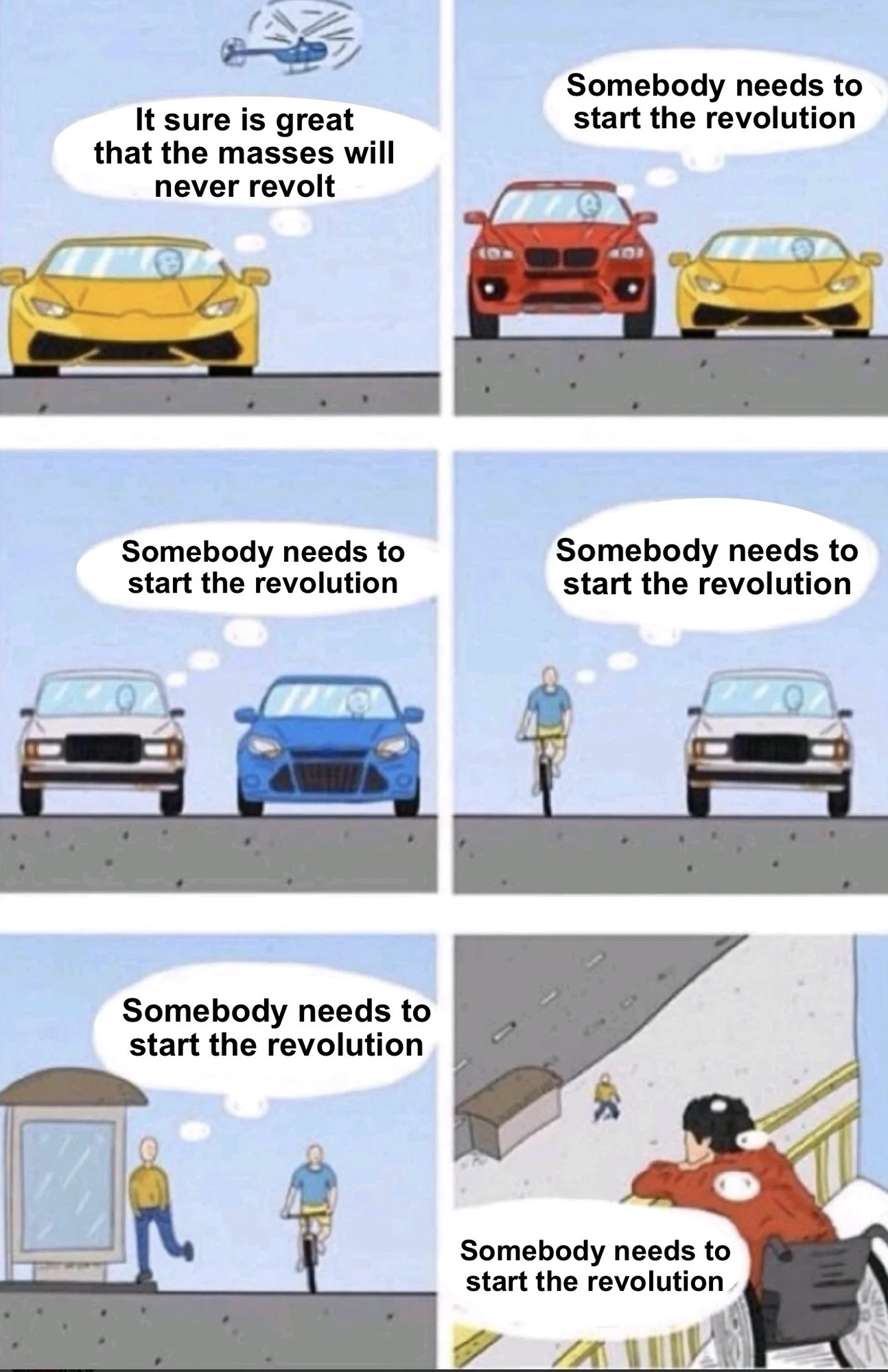
Yeah I don’t think there is a clear prescription for what a revolution looks like. I’d argue historically is mostly a matter of enough discontent building up and the a flash point.
Maybe Luigi was trying to be that flashpoint? Maybe not? Maybe they underestimated the degree of discontent? Maybe the pacifying effect of social media was too strong?
I’d argue that the people sitting on their hands are doing most of what you are arguing in your second paragraph. Sitting on their hands being unwilling to rip off a bandaid until conditions are almost fully manifest.
But realistically, that’s just not at all how popular revolts work. They are often unplanned, poorly administered, and a bit of a shit show while most of the details are getting figured out on the fly.
I think the sentiment you are expressing is part of why a popular revolution hasn’t manifest in the US. People are trained to expect things to be far more figured out than the actually can or need to be, before it’s time to act.
Realistically, some times you just gotta shit with the ass you got and figure out what to do about it later.
“Shit with the ass you’ve got.”
Got a new favorite phrase.
Unfortunately the vast majority of attempted revolutions fail, and when they do the result is often worse than if it hadn’t been attempted in the first place, with retribution coming down on the revolutionaries and anyone associated with them. These failures are usually down to poir or non-existant planning, as after the excitement of the initial surge there is no coherent plan to maintain it.
Any attempt at an armed revolt in the USA would, I am certain, be crushed with excessive force, and would delight the administration as an excuse to crush any dissent even harder. Worst, a thurd of the population would probably stand up and applaud the crushing.
I think that the only revolution that could reasonably be expected to lead to positive changes in the USA would be a massive, countrywide, coordinated, strike. That’s not going to happen without a lot of prior planning, building the support networks that would keep the strikers fed and housed for the duration, identifying the key industries and times to disrupt, working to win “hearts and minds” of those who maybe aren’t feeling the problems now, or whose world view makes this sort of action hard to imagine and making sure that people and supplies will be where they’re needed. Note that calling it a strike doesn’t mean it will be any easier that an armed uprising, but whilst the US government can bring overwhelming force to bear, the scales are much more evenly balanced when it comes to withdrawing labour. There will certainly be hardship for all involved, but good organisation and solidarity can mitigate the worst of that.