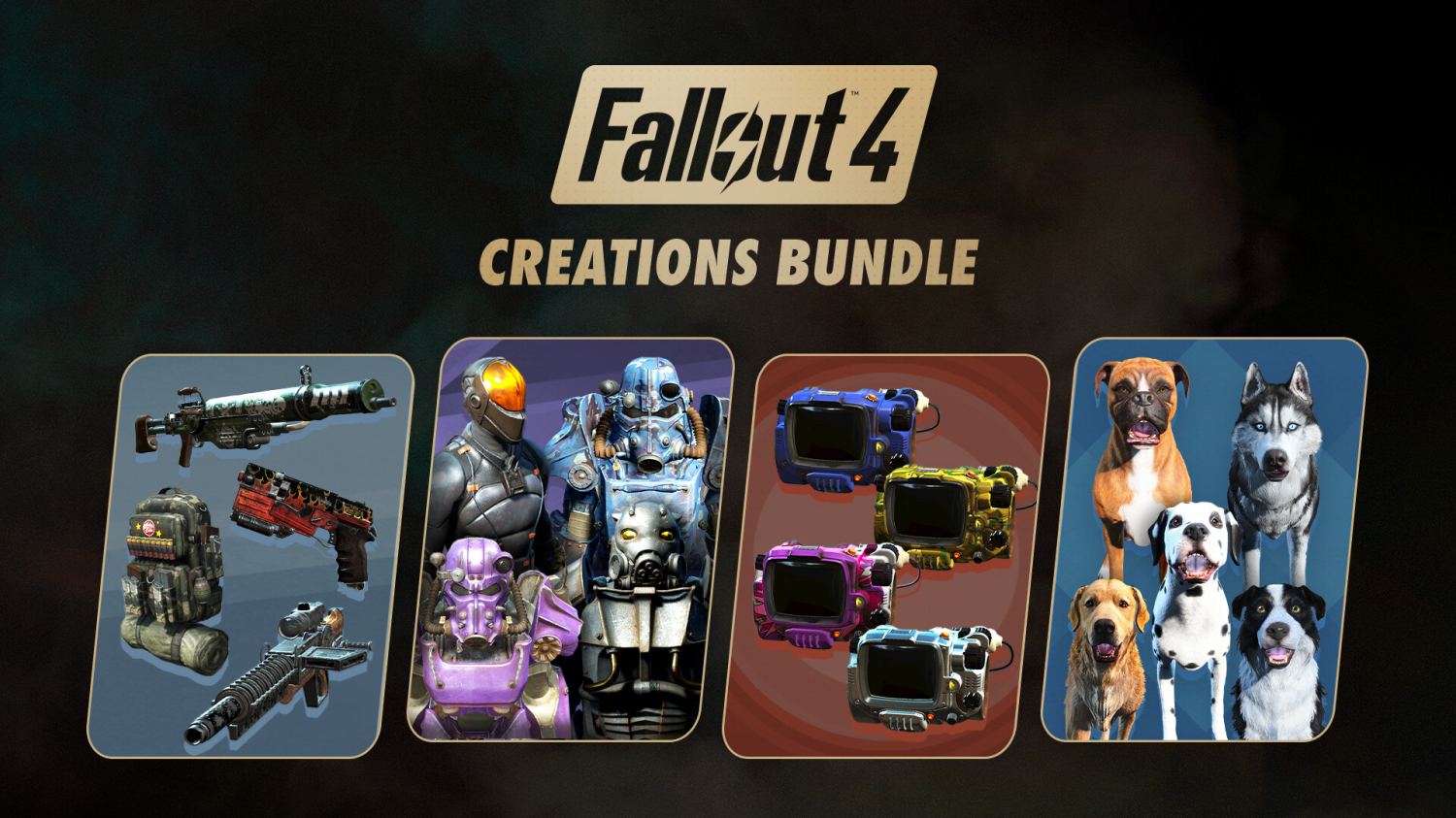
Man, I almost bought fallout 76 recently since it was on sale (I might still) but don’t want to deal with creation club money grab bullshit.
I have no plans on buying any mods from Bethesda.
Why?
Because there is no guarantee of interoperability.
With mods from Nexus and friends, I have no expectation of compatibility between gratis mods made by people in their free time. (even though mod authors usually go to great pains to make sure they’re compatible with most anything that isn’t another mod doing the same thing)
If I’m paying for a ‘mod’ (really just DLC) - I expect a paid level of support.
Until they make an update for “security” reasons which only allows mods to be installed through Bethesda. You know, for your safety and the children
I think that would kill a huge portion of Bethesda’s continuous player base, but equally it’s the type of truly awful decision that companies owned by Microsoft are liable to making, so youre probably spot on with this.
Funny how Baldur’s Gate 3 managed to do the same thing without any additional payment.
Not really surprising, they outsourced content creation to the community while pocketing a hefty cut from every transactions - free money with no effort involved, of course they don’t plan to stop it! My expectations for Elder Scrolls 6 were already rock bottom low and confirming that it absolutely will have Creation Club doesn’t help to raise the floor any higher.
My expectations have remodeled the basement.
My expectations have built a bdsm dungeon under the basement but instead of being filled with hot goth dominatrixes is filled with cuck chairs and those things in horror movies that they use to keep your eyes open without blinking
I’ve got to give credit to the gaming industry, it never fails to surprise me. They are extremely creative in finding new ways to press money out of gamers. I wish they would put that creative energy into their games, but well…
On the other hand, the gamers are not better. They pay for a weapon skin, a loot box, a mini DLC mission, they preorder, they accept always on line, they accept game clients required running in the background, buggy games on release date, now paid mods, kernel level anti cheat. Did I forget something?
Who can blame good old Todd and all the other guys?
Gamers wont even get off Windows because they wanna keep playing fortnight. By far the least scrupulous set of consumers on earth, ready and willing to sling hash for slop.
As for the gamers… I’d argue that most of those don’t “accept” but simply don’t know better. Ignorance is bliss.
Maybe get more people working on ES6 instead so it can launch before we’re all dead.
Avowed is pretty good.
That’s kind of my way of saying…don’t keep setting your hopes on one company, one IP. Brain drain is real. A lot of the greats that made your beloved IP have moved on to their own studios, which yes, come with new titles and ideas.
Yeah, I gave up hope waiting for FO5 before society falls.
Look on the bright side…
You’ll get to experience FO5 in real life.
My kid has been saying he hopes it happens. At the moment it’s just a fantasy of exploration and no school, and not some psychotic thing. I haven’t really explained yet how bad it will be, or how imminent it really is. Poor kid should get to be a kid as long as possible before he bears the weight of reality.
Lol ya then they will start collecting a percentage of the cuts. I love this typical corp speak trying to make it sound good for the people who put in the work when in the end they’re just gonna fuck us all over.
I generally agree that improving mod accessibility to the public is desirable.
I just stuck maybe a couple hundred mods into Starfield this week using Creations, including a number of paid ones. I’m fine with paid mods, but Bethesda still needs to deal with some basic issues.
-
While I had fewer problems than I had with installing mods on prior Bethesda games using third-party mod managers, the need to troubleshoot hasn’t gone away. I installed some high-resolution texture mods that crashed Starfield shortly after starting up, which made the Creations mod manager inaccessible. Bethesda doesn’t detect crashes in that scenario and offer a way to “roll back” to a “safe mode” or anything like that. I poked around a bit, and, as with their prior games, Starfield has a plugins.txt containing a list of modules loaded, and one can just remove the leading asterisk to disable them. But that’s going to be unacceptable for general use if you want all players to have access to mods. Either troubleshooting has to be pretty idiot-proof, or not be necessary at all. You definitely can’t put someone in a situation where they effectively can’t access the mod manager.
-
For more-advanced users, troubleshooting tools still aren’t great. Bethesda would benefit from something that can at least do a binary-search for a breaking mod: turn off the latter half of a problematic mod list, see if the problem goes away. If it does, the problem is in the latter half; repeat for that half. If it doesn’t, the problem is in the first half; repeat for that half. Various tools that I’ve used in the past can do this, like
git bisect. Conflict Catcher on the classic MacOS had a particularly good implementation that could detect multiple extensions that conflicted with each other; I’ve never seen another tool do this. -
Bethesda doesn’t, AFAICT, do adult mods in their own mod repository, which are popular for a number of their prior games. Nexusmods carries things that Creations doesn’t. LoversLab carries things that Nexusmods doesn’t. I appreciate if Microsoft doesn’t want to be in the business of distributing adult mods. However, I am confident that a lot of people would like to use those, as with prior Bethesda games. If one wants a lower bar to use, not requiring use of external mod managers would be desirable. I do think that extending the in-game mod manager to support external mod repositories would lower the barrier there. If Bethesda wants their game to be a platform, then that means more stuff strengthens the platform.
-
Loading time still increases as mod count rises, as with prior Bethesda games. It can easily take minutes. It should be possible, at bare minimum, to have a progress bar up showing about how long it’ll take to complete load based on prior loads, if the mod list hasn’t changed. Personally, I’d like to see the load time reduced. If they have to validate content or something or build an index, only do it the first time a mod list changes and then cache the index.
-
It’d be nice to have a “recommends” option. That is, if a mod requires another mod, when installing the first mod, ask the user if they want to install the latter mod. Nexusmods can do this. Bethesda’s Creations can’t — they will keep one from enabling an installed mod with missing dependencies, but the user basically needs to read mod descriptions and install appropriate dependency mods. That’s a barrier to use.
-
Bethesda’s Creations store just has abysmal filtering options. I get that it’s for a single game, and so it’s hard to amortize costs, but browsing through what’s there is just atrocious. You don’t have the ability to apply multiple criteria when searching for games.
-
The Creations store always re-downloads the list of Creations, instead of caching it. Exit Creations and go back in and everything gets re-downloaded again. This is obnoxious.
-
I understand that there are some technical limitations associated with the Creations mod manager. The Dark Mode for Terminals mod, for example, says that the Creations release cannot work around a bug associated with changing mod load order that the Nexus release doesn’t have a problem with.
-
One popular thing to make as mods in many games is skins or cosmetic changes, like to clothing or the like. Fallout: New Vegas and Fallout 4 had “cinematic kills”, where sometimes the camera would pan away, allowing one to see one’s own character. Starfield doesn’t do this, which means that there are few opportunities to see one’s character, unless one leaves the camera in third-person (which is generally not great from a gameplay standpoint). This is an issue that I also would say applies to Cyberpunk 2077’s clothing options — lots of work went into creating many clothing options, but one so rarely actually sees oneself in the game that it has little impact. Ditto for a number of cosmetic options, like hairstyle and the like. I think that it’d be beneficial if they could work some way to see oneself more frequently into the game in terms of people reskinning things.
-
For Fallout 76, Bethesda made money by mostly selling cosmetic items used by people who want to build themed player CAMPs. I was never personally very interested in building elaborate CAMPs just for the sake of looks, though clearly there are some people who are. However, my take is that these items were generally quite expensive compared to the cost of assets in the base game, though I’ll admit that I don’t know what volume they sell at. At least for me, the idea of paying for more content and functionality, to keep expanding that aspect of the game, is interesting. Buying cosmetic clutter items isn’t terribly interesting. I’m sure that they gather statistics on what players actually get, and Starfield’s Creations seem to me to have a different focus than the Fallout 76 Creations, so that’s good so far as it goes from my standpoint. My own interest would be in, say, getting new handcrafted cities and quests and the like. Getting a new player home or a different style of couch to put in it doesn’t really interest me nearly as much.
-
I am pretty convinced that if Bethesda wants to have a low bar to extensively-modded games for the general playerbase, they’re going to have native support for something like Wabbajack. That lets one player or team assemble a curated mod collection, and then lets other users install it en masse. I’m not saying that using mods should end there, but my experience is that, years after a Bethesda game has come out, there are many different mods in similar areas (e.g. relighting mods, say). Some of those are successor mods. Some have advantages and drawbacks. Trying to evaluate what the best “current” choice is for a wide variety of mod types is a large task. Letting someone just choose from a list of “mod collections” and easily install all of the mods in a collection would, I think, greatly reduce the bar to get players able to use many mods at once.
Well written comment, but I think all of it is absolutely wishful thinking. Bethesda will not replace the creation engine in any future releases for games to solve their games issues with stability and performance (and let’s be honest with ourselves, that is the only way they will be fixed), they will do the absolute bare minimum for curating any content or general bug testing (Fallout 76, need I say more), and to expect a public company with every incentive in the world to enshittify to provide a better user experience for user created content than the unofficial alternatives for the long term is hilarious.
For another example of a Microsoft owned property that has the same divide of community vs. official avenues of distributing and managing modded content, compare modded Minecraft Java Edition to Bedrock (sorry, Bugrock). I would not consider moving Bethesda’s modding scene closer to the Bugrock model to be “desireable”.
Half the things you are describing here are basically just core game systems that should already exist within the product you paid for.
The reason that a lot of more comprehensive mods exist and work for older Bethesda games is that they’ve been around long enough that people have figured out how to essentially hijack the exe itself, and input custom low level c++ commands, usually via a higher level scripting language.
This category of mods is generally called a script extender.
Script extenders exist because the game is fundamentally so limited and/or broken, and proper modding tools do not exist.
Then, people build the fancier mods on top of the script extender mods.
Bethesda is not capable of creating proper modding tools, because their engine and games are fundamentally too unstable, they’re a spaghetti code mess.
Poke one thing here, and something seemingly completely unrelated breaks somewhere else, because they used a hacky solution 4 years ago once, and then that got forgotten about… multiply that by 100 or 1000.
They would have to actually have a base game and engine that is stable and follows consistent rules, ie, they’d have to refactor everything.
But refactoring everything is expensive and takes time and does not produce more money within a a quarter of its completion.
And also, with Fallout 4 recently, well they actually tried to refactor it, and basically they failed; game just has all new classes and categories of bugs now.
They’re literally not capable of meaningfully improving the situation.
Also, a Wabbajack type solution will never work stably and consistently for the same reason that Nexus Mod Collections very often don’t work:
Now you are just compounding the spaghetti code problem with 10s to 100s of different mod authors, of varying levels of competency, using varying kinds of hacky solutions, which may or may not ‘poke’ each other in essentially random places.
You could maybe get something like that working on only a console, but its basically impossible to also get that stably and consistently working on every possible arrary of hardware and software that a PC user could be using.
Unless of course they actually sucessfully refactored everything, and then has a mod verification system that involved extensive testing.
But basically no one in the software industry has done thorough testing in over a decade now, because it is expensive and time consuming.
Half the things you are describing here are basically just core game systems that should already exist within the product you paid for.
Yes, that’s their entire point.
-