cross-posted from: https://programming.dev/post/48079645 because it was headshotted within five minutes without any explanation. :/
In the laundry room where I live, there is this machine.
The fan in the back blows air onto the heating elements that heat up the air, which in turn hits the laundry, speeding up the evaporation of the water.
I have no formal education on electricity, I’m just extremely interested and eager to learn. I think I understand that the rods heat up because enough current is “pushed” with enough voltage through this material that has enough resistance for it to heat up.
If these are the hot and neutral rods next to each other (which I visually believe I confirmed) with no insulator in between, why is there no arcing?
What are prerequisites for arcing? I guess, if arcing occurred so easily, then we would have a lot more ground faults and short circuits all over electrical installations?


Those are calrod elements. The resistive coil is inside that tube. The bolts hold the steel shell. The affixing nuts hold the outer casing and are not conducting electricity.

The insulation can fail and the inner coil will touch the shell, although I’ve only seen it happen once. Blew a hole in the bottom of a pot in dramatic fashion.
Edit to add: I am a huge fan of “Teach Yourself Electricity and Electronics” by Stan Gibilisco, which is now in its 7th edition. Back in the 90s, I got my start with the 2nd edition. Here’s the 4th for free on Internet Archive: https://archive.org/details/teachyourselfele00stan
Sic! Thank you so much for the visual aid too! :D “Calrod elements”. I’m gonna spread that word and knowledge of it like there was no tomorrow.
Thanks!
What are prerequisites for arcing?
https://en.wikipedia.org/wiki/Paschen's_law
To oversimplify, you need around 3000 volts to jump an arc 1mm.
Yeah! Thanks for the link! This’ll be my bedtime story tonight. XD
Like JayleneSlide mentioned, those elements aren’t actually live as pictured, that’s the outer casing. But even if they were live, they wouldn’t arc at that distance.
A general rule of thumb for arc distance in air on earth is 1000V per 1mm. That means that each nut would have to be 0.24mm apart from each other (assuming 240v, it’d be 0.12mm or about 0.004 inches in a 120v country) to start arcing.
Once the arc starts, that distance can increase. This is because arcs will ionise the air, creating a lower conduction path for further arcing. This will continue until the hot ionised air rises away from the conduction path and gets too long to sustain the arcs.
But in any case, those nuts will never arc for a second reason; if they were live they would be dead shorted to each other anyway through the metal case that they’re bolted to.
Right! I was actually wondering why I wasn’t zapped by the outer casing or why there’s no warning sign about electrical current. Now it makes sense! :)
I’m not an electric engineer by any means but electrons take the path of least resistance. In this case the heating element is still less resistance than arcing through air. Keep in mind the distance between prongs in an electric plug is just as close.
If you straightened out a paperclip and threw it in there you would probably see what you are asking about. Or a stick of graphite(pencil lead) if you really want fireworks. Don’t do either of these things, though. You could be shocked by the current and even more shocked by medical and legal bills.
Thanks! I needed a good laugh. And also thanks for teaching me about the graphite! :D
I don’t have much experience with heating elements specifically, but hers what I found;
This type of heating element is called Calrod (a trademarked name). Here’s a cross section :
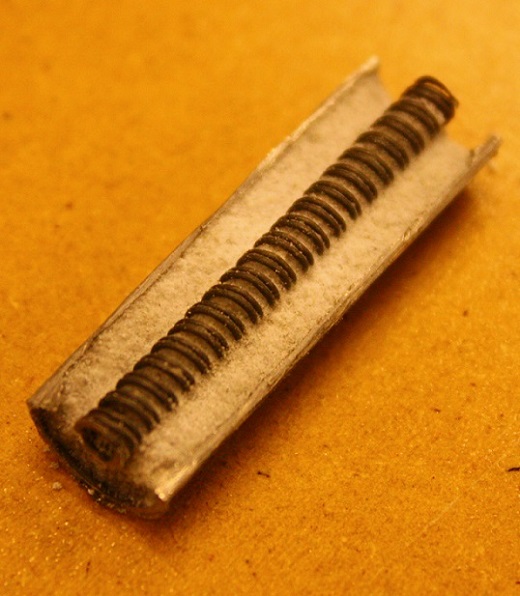
As you can see, there’s stuff inside the visible tube. The spiral inside is the actual “wire”, through which current flows, and that heats up (see also: Joule’s Law).
Then there’s a layer of magnesium oxyde, which is an insulator. This is what keeps the current from going away from the wires.
The outside sheath that you see is just some stainless steel tubing that keeps the (powdery) magnesium oxyde in.
why is there no arcing?
On the topic of arcing; an arc is a very specific phenomenon. Usually, air is an insulator. However, under very high voltage, current can start to cross air gaps. In doing so, it heats up the air a lot, creating a plasma. This plasma conducts electricity (at least it can do so better than plain air), so once the air is “broken”, current can flow through the air gap. I don’t know the exact numbers, and it depends on the gap size, but an arc requires at least a few kilovolts to appear.
Sidenote: when you get a zap when touching something metallic after you’ve worn slippers, that’s because you’ve actually gained a few kilovolts of charge compared to the metallic thing, and you’ve made a (very short lived) arc!
Thanks for the reference to Joule’s law and to static discharge! :D And great image of a Calrod element!
Thanks for posting this. It’s one of those things I’ve always wanted to know but never remembered to ask. Cheers!
What are prerequisites for arcing?
Each insulator (air is one) has an specific minimum voltage/distance ratio for an arc to appear.
Those probably wouldn’t arc even if their surface was electrified. But as a sibling already noted, their surface is insulated. They would be extremely sensitive to any kind of dirty, though.
Sweet! I’m gonna look up those ratios. Would be cool to see if there are calculations on arcing in vacuum.
If you want to look:
https://en.wikipedia.org/wiki/Breakdown_voltage
https://en.wikipedia.org/wiki/Paschen's_law
Technically there are no arcs in vacuum. Things work differently there, the discharge voltage depends on the electrode material and temperature.