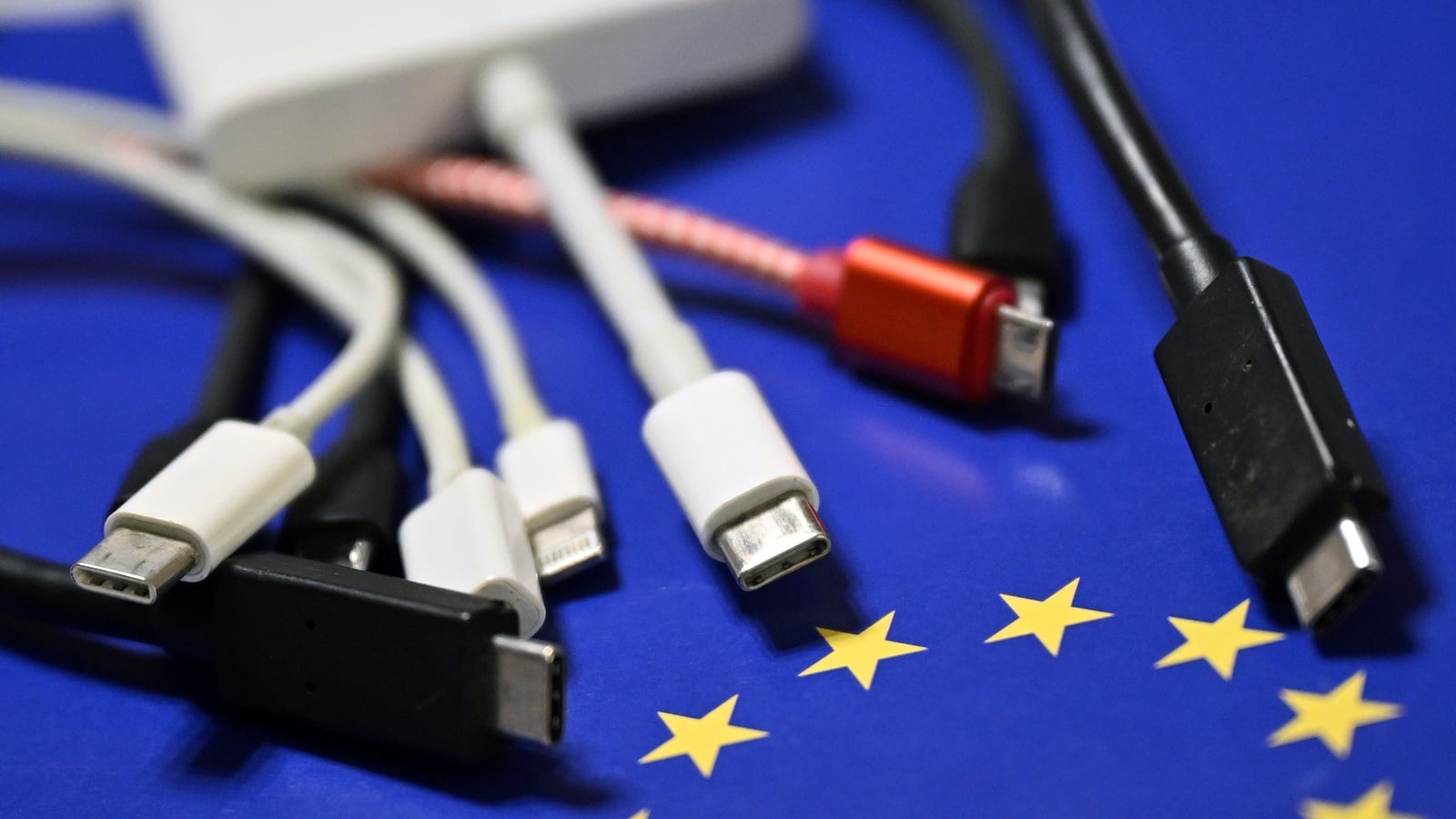
EU rules on common chargers apply to laptops from today. It means that all new laptops sold in the European Union must now support USB-C charging.
In December 2024, the rules came into force for mobile phones, tablets, digital cameras, headphones, videogame consoles, and portable speakers.
Laptop manufacturers were given a longer lead in time to allow for redesign and transition to the common charging system.
I just love the EU. Not perfect of course, but this kind of stuff is great.
Nothing is perfect, but the EU is by far the best government entity for consumers right now.
the best
Low bar though. I’ll not forget Chat Control. Dieselgate, Qatargate, or Ursula’s unelectedness.
“Unelected Ursula” is directly from the Russian disinformation playbook btw.
I’m OOTL, what is that?
Pick a mainstream social media site, find a post/video about the EU. If Ursula Ledoyen is in it, the comments will be full of comments Super Concerned that she wasn’t “properly elected”. Within 15-30 minutes of it being posted.
Perfectly organic and posted by normal concerned EU citizens. Yep yep.
AstroTurf, when regular turf simply won’t do.
Implying I’m a shill, nice one.
No, he is implying you are sharing misinformation. Misinformation works because most people who share it are earnest.
No, just someone who ate up their misinformation
How is dieselgate the fault of the EU? The main offender was Volkswagen. Chat Control and Qatargate are the result of lobbying and corruption, and while the EU is not immune to this kind of influences (being a government body made by people), the aggregate result of EU bureaucracy is much better then any other power block currently active in the world in my opinion.
In June 2016, documents leaked to the press indicated that in 2010, European Commission officials had been warned by their in-house science team that at least one car manufacturer was possibly using a NOx-related defeat device in order to bypass emission regulation.
While this is totally true, you cannot fault the EU for not acting on the in-house science team info given the EU commission had no authority on policing car manufacturers. At the time that was the duty of national authorities. Now the EU commission has granted itself the power to conduct vehicle audits and fine those responsible. Positives changes over embarrassing scandals are a positive outcome to me, and not the norm in modern politics.
Chat Control was still a proposal made by a few politicians in a big continent. Never an EU made innitiative of any kind, and never voted through.
And I think you should read about the democratic system in the EU, if you want to challenge how she was elected.
She’s elected how most of European countries elect their presidents. You vote for parties, and then after; one among them will be president. Typically the head figure from the biggest party.
We should be very glad it’s not an election like in the US. Awful way of giving “power” to the people, by putting a single person in charge by popular vote.
The way Ursula obtained that re-election was not pretty. Perhaps not as unsightly as Trump’s second rise to power, but still not a resounding show of democracy.
Referring to member states that don’t have their shit in order is as weak as the low bar set by OP.
The source of law here is Directive 2022/2380 (which amends Directive 2014/53), in Article 2 a grace period until 2026-04-28 is defined for the category of laptops. This has now expired, which explains the renewed wave of articles being published.
The directive itself is not that interesting to read, as a lot of it is just empowering the Commission to make a decision on the specifics. The result is in the Commission Delegated Regulation 2023/1717. Although it seems to me like something is missing. I can’t find more though.
A very interesting Q&A from their Commission Notice – Guidance document:
- Are laptops and other radio equipment that require more than 240 W of charging power exempted from the ‘common charger’ rules?
No. They are not exempted. Radio equipment which is subject to the ‘common charger’ rules must incorporate the harmonised charging solution.
The Commission has updated (in Commission Delegated Regulation (EU) 2023/1717), the references to the standards cited in Annex Ia to the latest version of the European standards. Therefore, due to the amendments introduced by this delegated regulation, radio equipment subject to the ‘common charger’ rules must incorporate the harmonised charging solution up to their maximum charging power or up to 240W if their maximum charging power is above 240W (as opposed to 100W in the previous versions of the standards concerned).
The Commission will continue to update the technical specifications set out in Annex Ia, in order to reflect scientific and technological progress or market developments provided that such developments meet the objectives of the common charging solution.
But then also
- Are proprietary charging receptacles allowed in addition to a USB-C receptacle?
Yes. The RED only requires radio equipment subject to the ‘common charger’ rules to be equipped with the USB-C receptacle. The use of other receptacles is therefore not prohibited as long as the covered radio equipment is also equipped with a harmonised charging (USB-C) receptacle.
That means those hefty laptops going up to 350 W or whatever, now need to accept 240 W over USB PD, but they may still include additional proprietary charging solutions that are rated higher.
Also I don’t think the 100 W limit that some outlets report is actually in force since 2023/1717 has replaced the references to ‘EN IEC 62680-1-3:2021’ by those to ‘EN IEC 62680-1-3:2022’
Reading on, yes they make that explicit further down:
- Is a radio equipment allowed to charge above 240 W when using an additional charging protocol?
Yes. If the radio equipment proprietary charging solution requires more than 240 W (e.g. 300 W), the concerned radio equipment must also support USB PD up to 240W.
The Commission has updated, via Commission Delegated Regulation (EU) 2023/1717, the references to the standards cited in Annex Ia to the latest version of the European standards. The updated version of the standards will apply as of the date of applicability of the relevant rules introduced to the RED by the Common Charger Directive, i.e. for handheld mobile phones, tablets, digital cameras, headphones, headsets, handheld videogame consoles, portable speakers, e-readers, keyboards, mice, portable navigation systems and earbuds, as of 28 December 2024 and, for laptops, as of 28 April 2026. This means that as from those dates a radio equipment, if it listed in Annex Ia and is capable to be recharged by means of wired charging at power above 240 W, must incorporate the harmonised charging solution up to 240 W.
The Commission will continue to update the technical specifications set out in Annex Ia, in order to reflect scientific and technological progress or market developments provided that they meet the objectives of the common charging solution.
The article doesn’t mention the requirement’s 100W limit.
Edit: Per reply, the regulation is designed with 240W accounted for, and updatable in case of further improvements to the standard.
Glad you did, because I was gonna make a comment about how high end gaming laptops are now illegal in the EU.
Not sure there’s a 330w USB C going around I could use.
The limit should really be 240W, because that’s what the USB-C PD 3.1 spec goes up to.
Edit: Per reply, the regulation is designed with 240W accounted for, and updatable in case of further improvements to the standard.
It is 240 W actually. Seems Techpowerup was wrong. See my first comment: https://discuss.tchncs.de/post/59511400/25528592
When you make minimum requirements, you dont go for max. All laptops shouldnt be able to take 240W.
Laptops can be rated for whichever power level the manufacturer prefers; USB-C PD is used between the power supply and device to negotiate the maximum power level allowed for by both, so a consumer that purchases a 100W or 240W cable and power supply could still use them with a lower-rated device.
A 60W USB-C laptop can therefore stay at 60W without issue, but if a 240W laptop is produced, it should also be made to use USB-C under such a regulation.
Fair point. But it will still be overkill to require 240W for a device that will never take it.
I know it will regulate output. But requirements should make sense.
Nope, still perfectly legal. Proprietary charging ports are allowed but have to be accompanied by a USB PD port that supports the same wattage (or 240 W if the device needs more than that).
So basically the law says “devices must support USB PD”, not “devices must only support USB PD”.
Gaming laptops can continue to use the typical barrel power connector on models that exceed 100 W of power
Mines not a barrel either, big ol rectangle
Laptops above 100W don’t need a USBC charging port.
Can’t the provider just make two charging ports?
They can.
USB-C goes up to 240 W now and the law has been amended to acknowledge the new USB PD spec. Devices are also allowed to have proprietary charging ports but must include a USB-C port capable of showing the full power draw of the device (or 240 W of they need more than that).
So a big gaming laptop might have a USB PD-capable port that supports 240 W and a barrel jack that supports 350 W.
Putting “Universal” back in “USB”
I bet it’s not available on Jupiter.
So the shape of the plug is the same for all devices regardless of the spec… doesn’t it just make things more confusing for non techies? I can already see people saying their new laptop is broken because their 5v 0.67A power brick won’t charge it, or buying a USB-c charger just to find out it doesn’t work. A lot of aftermarket chargers claim to support up to 120W etc. Except they mean 120W is a sum of all ports for a 6 port charger so really it’s only 20W. For techies it can get annoying too if you like to play with hardware. You can just feed appropriate voltage DC over those barrel connectors, for example from a car battery with a buck converter or AA/18650 in series and it will work while usb-c charging needs to be negotiated.
If you plug in a weak charger or an inadequate cable you will get a message on the screen saying as much. Also, the new law doesn’t prevent manufacturers shipping proprietary chargers alongside USB-C.
Apple in shambles
Macs have had USB-C charging since 2015.
This was, in many respects, a downgrade, since Apple’s proprietary MagSafe was seen by many as a valuable feature. Power cords that pop out rather than yanking the laptop off the desk if someone trips over it are pretty handy.
In 2021 Apple started re-including MagSafe on their laptops. But since doing so, the USB-C ports have also been able to charge the laptop.
So since 2015 they’ve been compliant with this law, and since 2021 they’ve had the best of both worlds, with either option working.
I wouldn’t mind a USB-C sub type that works like that, just the connector is yankable like that, yet it’s pure USB-C and fucking compatible
Because if you think that Apple added this port just and only because of the yankable cable, and not to again be purposely be incompatible so they can squeeze more money out of you, then I have a bridge to sell you…
Usb c adapters like that exists
https://www.amazon.com/Magtame/dp/B0DM5HGC5H?source=ps-sl-shoppingads-lpcontext&psc=1
Now make them put a port on each side of the laptop!
What if the ports are recessed and you have built in dongles you can swap to change the port type on either slot?
Oh wait, framework did it :)
Though, to be fair, Framework laptops can’t charge from all of their ports. The 16 can charge from one port each per side; not sure about the 13 and 12.
Well, I have a 16 and it can be charged on 4 out of the 6 ports. It is true though that not all ports are equal. Some supporting display, others not, some consuming more power when a USB-A is plugged into them etc.
The diagram is here: https://knowledgebase.frame.work/expansion-card-slot-functionality-on-framework-laptop-16-amd-ryzen-7040-series-rkUjGm7cn
The 13 (amd) can charge from either side not sure if the ports closer to the keyboard also charge at the same speed
Edit: Apparently they do. (negotiating 3A PD on a first come first serve basis)