Yup, this is every job. Your skills at performing a task are only a small part of success. The bigger part is being able to make friends with the right people.
Edison and Tesla come to mind. Edison wasn’t the best when it came to electrical engineering but he was good at talking. Tesla was brilliant and is the father of modern electrical engineering but his best friend was a pigeon. During their lifetimes, Edison was much more successful than Tesla was.
Yeah, while I can relate to her plight, its pretty much the same situation when you do research in the industry and you want to get ahead in your career. Some things are different, but politics are still politics.
Completely ignoring qualification altogether in favor of nepotistic back scratching is actually not just being a member of society. IMO, HR should hide the identifying information of candidates from people making the hiring decisions so all they’ve got is the qualifications on the resume to judge them by.
That’s just not how the world works though… you will have to work with at least 1 person at a job (your boss), so you should be able to work well with at least 1 person. That doesn’t come through with just a resume.
So get a written interview in or a voice call if you really have to “like…get their vibe man!” But who you know hiring has to fucking stop. It is intentionally making worse decisions because you don’t like someone as much as someone else.
I’d rather hire someone I know is a decent, stand up guy that is easy to work with even if they are not as qualified as a rando, as long as they’re qualified enough. I’m sure this is not always the case, like maybe I need a specialist for a single thing or a consultant or whatnot. But I put a lot of value on personality in general.
Though I guess it also depends how easy it is to fire someone if they’re not what you wanted.
IMO, HR should hide the identifying information of candidates from people making the hiring decisions
That would shift towards another metric of whose resumes look the best. That might be an improvement, but we’d still be talking about how much bullshit there is in making your resume perfectly tailored to a particular opportunity. And at that point we’re still talking about the skills that go into a grant application or a submission of a paper to a conference. That’s the soft skills that make science possible, even if submissions are anonymized.
That just what being a member of society is, lots of overhead.
I think it’s mostly that you can’t expect people foreign to your field to understand how valuable your work is, you need to communicate it to them. Then there’s a fine line between popularization and bullshiting that your sense of ethics will make you cross or not depending on the situation.
I appreciate the sentiment but no - in the case of hard science it shouldn’t be.
Yes, BS exists everywhere, yes we all have to do it, yes yes yes but this is science. Only facts should matter, only agreed truth should be the topic the rest of it is very obviously poisoning the entirety of the effort to understand our world.
Saying “so what we all have to deal with it” is not the point. If you’re talking about seminary, that’s maybe closer(?) to the gist than, say, marketing. Or if you’re a systems analyst for the USPS it’s similar maybe. But people out in the world doing non-scientific things have already agreed long ago that it doesn’t really matter what they find or how they find it (so long as it leads to more money, the only source of “truth”) - science does not.
All the bullshit and pointless politics and ladders and so on she’s talking about in the quote are just ways to say “money” (or “power”) for science which is an anathema.
Only facts should matter, only agreed truth should be the topic the rest of it is very obviously poisoning the entirety of the effort to understand our world.
I don’t understand how you’d prioritize things using only facts, and not some kind of extrinsic value system that assigns weights to those facts.
Let’s say you have a huge infrared telescope sitting at a Lagrange point, between the earth and the sun. How would you determine what it should be observing at any given time? There’s only 8760 hours in a year, and the telescope was designed to last for 5 years, with the hope of 10 years. How do you divide up that finite resource?
Now do the same for every particle collider, double blind medical study, paleontological excavation, test nuclear reactor, etc., fighting for a finite amount of science money, and you’ll have no choice but to define priorities according to projections and uncertainties and value judgments.
Are committee meetings immune to runaway political madness? Who’s on the committee? How does the committee make decisions? Can those decisions be revisited?
I’m not convinced that today’s state of science is any different than in eras past, tracing all the way back to kings and wealthy patrons throwing their political and economic might behind their preferred scientific endeavors.
One thing is how the world is, and another is how the world should be. The person you’re replying to accurately depicts how the world is as of today, but isn’t saying that is how it should be, which is what you’re arguing.


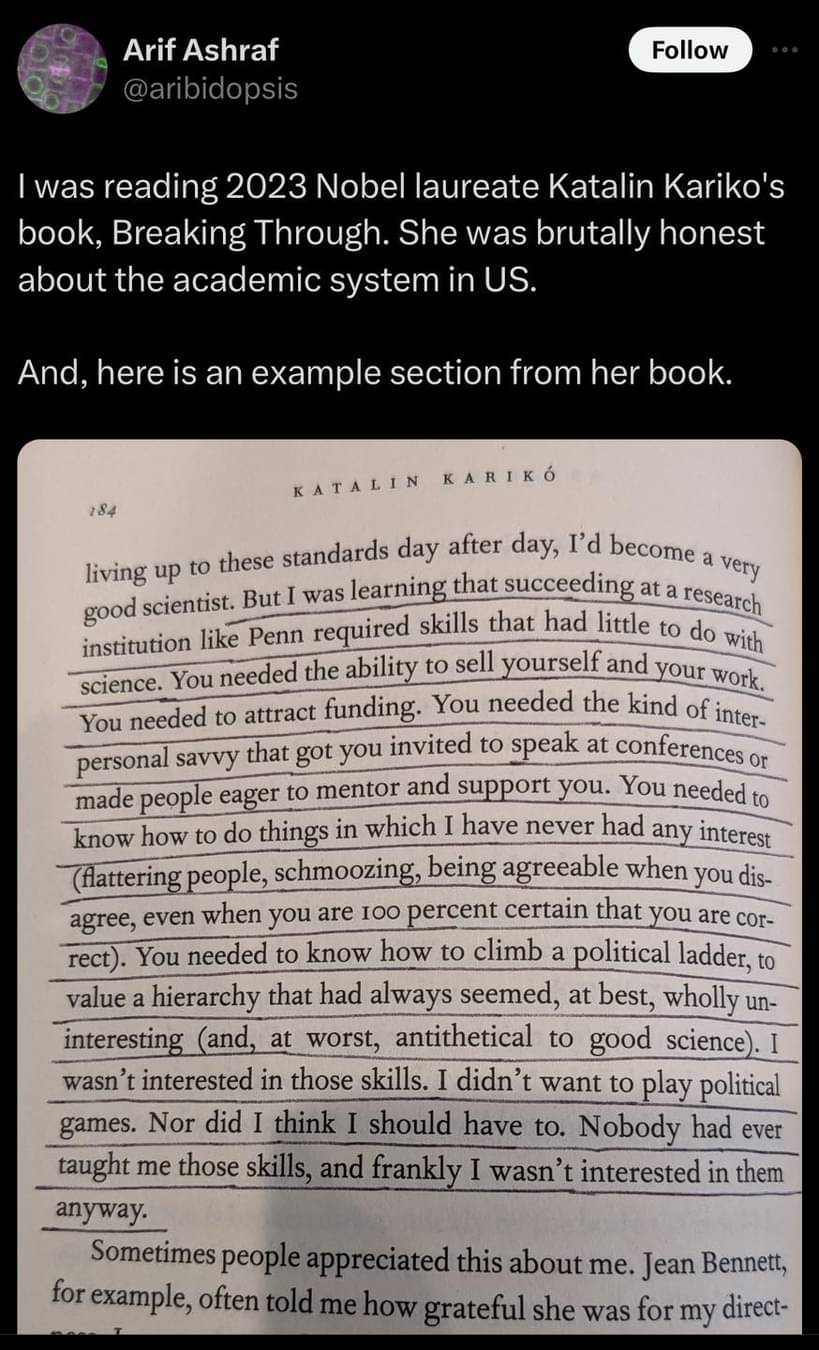
That just what being a member of society is, lots of overhead.
Autistic people often face these challenges even outside of science.
Yup, this is every job. Your skills at performing a task are only a small part of success. The bigger part is being able to make friends with the right people.
Edison and Tesla come to mind. Edison wasn’t the best when it came to electrical engineering but he was good at talking. Tesla was brilliant and is the father of modern electrical engineering but his best friend was a pigeon. During their lifetimes, Edison was much more successful than Tesla was.
Yeah, while I can relate to her plight, its pretty much the same situation when you do research in the industry and you want to get ahead in your career. Some things are different, but politics are still politics.
deleted by creator
Completely ignoring qualification altogether in favor of nepotistic back scratching is actually not just being a member of society. IMO, HR should hide the identifying information of candidates from people making the hiring decisions so all they’ve got is the qualifications on the resume to judge them by.
That’s just not how the world works though… you will have to work with at least 1 person at a job (your boss), so you should be able to work well with at least 1 person. That doesn’t come through with just a resume.
So get a written interview in or a voice call if you really have to “like…get their vibe man!” But who you know hiring has to fucking stop. It is intentionally making worse decisions because you don’t like someone as much as someone else.
deleted by creator
I’d rather hire someone I know is a decent, stand up guy that is easy to work with even if they are not as qualified as a rando, as long as they’re qualified enough. I’m sure this is not always the case, like maybe I need a specialist for a single thing or a consultant or whatnot. But I put a lot of value on personality in general.
Though I guess it also depends how easy it is to fire someone if they’re not what you wanted.
deleted by creator
deleted by creator
That would shift towards another metric of whose resumes look the best. That might be an improvement, but we’d still be talking about how much bullshit there is in making your resume perfectly tailored to a particular opportunity. And at that point we’re still talking about the skills that go into a grant application or a submission of a paper to a conference. That’s the soft skills that make science possible, even if submissions are anonymized.
I think it’s mostly that you can’t expect people foreign to your field to understand how valuable your work is, you need to communicate it to them. Then there’s a fine line between popularization and bullshiting that your sense of ethics will make you cross or not depending on the situation.
I appreciate the sentiment but no - in the case of hard science it shouldn’t be.
Yes, BS exists everywhere, yes we all have to do it, yes yes yes but this is science. Only facts should matter, only agreed truth should be the topic the rest of it is very obviously poisoning the entirety of the effort to understand our world.
Saying “so what we all have to deal with it” is not the point. If you’re talking about seminary, that’s maybe closer(?) to the gist than, say, marketing. Or if you’re a systems analyst for the USPS it’s similar maybe. But people out in the world doing non-scientific things have already agreed long ago that it doesn’t really matter what they find or how they find it (so long as it leads to more money, the only source of “truth”) - science does not.
All the bullshit and pointless politics and ladders and so on she’s talking about in the quote are just ways to say “money” (or “power”) for science which is an anathema.
And in the social sciences, we’re really fucked.
I don’t understand how you’d prioritize things using only facts, and not some kind of extrinsic value system that assigns weights to those facts.
Let’s say you have a huge infrared telescope sitting at a Lagrange point, between the earth and the sun. How would you determine what it should be observing at any given time? There’s only 8760 hours in a year, and the telescope was designed to last for 5 years, with the hope of 10 years. How do you divide up that finite resource?
Now do the same for every particle collider, double blind medical study, paleontological excavation, test nuclear reactor, etc., fighting for a finite amount of science money, and you’ll have no choice but to define priorities according to projections and uncertainties and value judgments.
Necessary evils, such as committee meetings, vs. runaway political madness suppressing actual work.
The former is implied by organization, the latter is more prevalent than ever in the state of modern science (because money).
Are committee meetings immune to runaway political madness? Who’s on the committee? How does the committee make decisions? Can those decisions be revisited?
I’m not convinced that today’s state of science is any different than in eras past, tracing all the way back to kings and wealthy patrons throwing their political and economic might behind their preferred scientific endeavors.
One thing is how the world is, and another is how the world should be. The person you’re replying to accurately depicts how the world is as of today, but isn’t saying that is how it should be, which is what you’re arguing.
What if everyone else is just one person with all the other bodies?