The inter-distro drama is really quite funny. The vast majority of Linux distros are, in fact, systemd distros. They use the same kernel, libc, userland, boot manager, etc. Some components and defaults are different, KDE over Gnome or Zsh over Bash, but really the only meaningful difference between Arch and Mint is the package management philosophy. There are some truly unique distros with fairly substantial differences in both philosophy and technology I love recommending. My two favorites are Nura (formerly PostmarketOS) and Chimera Linux with KaOS as an honorable mention. But these are such small and niche projects that no one really argues over them, it’s more about the very similar Mint VS Arch. So why the fuck do Linux users argue over them? There’s reasons for both, so why not argue over something productive like text editors? But not omarchy, fuck whoever is the “dev” of the project.
Yeah, there’s not much fundamentally different between distros, just what packages you can install and how, what kernel gets shipped and then the desktop environment. These shouldn’t cause drama tbh because they’re just preferences.
I think you’re understating the differences between distros just a little bit. There’s a lot of other things that make differentiate distros from each other, such as…
Ease of installation
Ease of updating to a new release
Stability and commitment to support windows
Availability of packages in the repository
General project maintenance (example: see how many times Manjaro has let certificates expire)
Philosophy and general approach to security
General policies of the project, often having to do with legal things like video codecs, distributing graphics drivers, software licenses, and “AI”
Drivers (Nvidia vs. nouveau for example)
Most of these aren’t a major reason for drama of course. But while the software is mostly just the same with different versions, there are still a lot of important factors that go into creating or choosing a distro. I do agree though that most of these are insignificant or invisible for most users though.
Sometimes I wonder how many of these people are actually engineers/developers vs people who learned how to use a particular distro very well, and they don’t like how they can’t adopt other distros easily.
I think we can all say “fuck omarchy” and agree on that though.
It’s also understandable. The way these beginner friendly sites for teaching Linux and technology are worded (Geeks for Geeks, Baeldung, etc.), they make it sound like there is some massive difference between distros. The way these sites tend to present information is unfortunate. I sometimes use them to figure out broadly what commands can be used for a task or maybe simple script syntax, but they are by no means a substitute for reading the manual. I’m also not saying there is not a place for these kinds of sites; most people don’t want to understand how the machine works. What is the problem is that they present themselves as though they are teaching how the machine works, when they aren’t even the tip of the iceberg.
but really the only meaningful difference between Arch and Mint is the package management philosophy.
Don’t forget the defaults.
Most people aren’t looking to install a different desktop environment, and they’ll stick with the distro that ships with what they like. If I want to use Cinnamon, it’s infinitely easier to use Mint, which has it pre-configured.
I think people just want to feel validated in their choice, but as you said there really is no “best”. There’s just a bunch of choices, each with strengths and weaknesses, and a whole lot of unnecessary elitism.


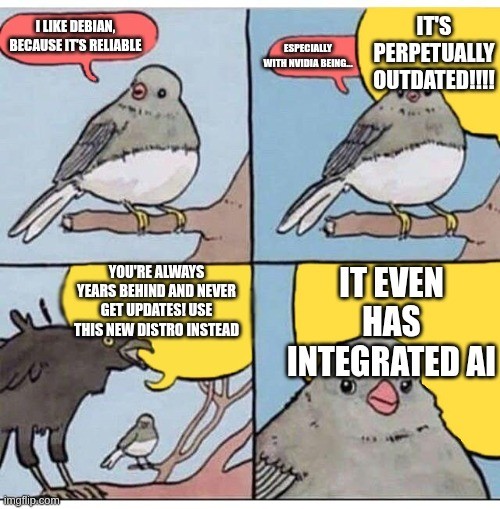
The inter-distro drama is really quite funny. The vast majority of Linux distros are, in fact, systemd distros. They use the same kernel, libc, userland, boot manager, etc. Some components and defaults are different, KDE over Gnome or Zsh over Bash, but really the only meaningful difference between Arch and Mint is the package management philosophy. There are some truly unique distros with fairly substantial differences in both philosophy and technology I love recommending. My two favorites are Nura (formerly PostmarketOS) and Chimera Linux with KaOS as an honorable mention. But these are such small and niche projects that no one really argues over them, it’s more about the very similar Mint VS Arch. So why the fuck do Linux users argue over them? There’s reasons for both, so why not argue over something productive like text editors? But not omarchy, fuck whoever is the “dev” of the project.
Yeah, there’s not much fundamentally different between distros, just what packages you can install and how, what kernel gets shipped and then the desktop environment. These shouldn’t cause drama tbh because they’re just preferences.
I think you’re understating the differences between distros just a little bit. There’s a lot of other things that make differentiate distros from each other, such as…
Most of these aren’t a major reason for drama of course. But while the software is mostly just the same with different versions, there are still a lot of important factors that go into creating or choosing a distro. I do agree though that most of these are insignificant or invisible for most users though.
Sometimes I wonder how many of these people are actually engineers/developers vs people who learned how to use a particular distro very well, and they don’t like how they can’t adopt other distros easily.
I think we can all say “fuck omarchy” and agree on that though.
It’s also understandable. The way these beginner friendly sites for teaching Linux and technology are worded (Geeks for Geeks, Baeldung, etc.), they make it sound like there is some massive difference between distros. The way these sites tend to present information is unfortunate. I sometimes use them to figure out broadly what commands can be used for a task or maybe simple script syntax, but they are by no means a substitute for reading the manual. I’m also not saying there is not a place for these kinds of sites; most people don’t want to understand how the machine works. What is the problem is that they present themselves as though they are teaching how the machine works, when they aren’t even the tip of the iceberg.
My undergrad was in electrical and computer - I don’t think that touched the tip of the iceberg.
Yeah, your right. I always love blowing peoples’ minds explaining microcode. Computers are… strange.
I’m still amazed by the number of people who doubt me on the magic smoke in ICs.
Don’t forget the defaults.
Most people aren’t looking to install a different desktop environment, and they’ll stick with the distro that ships with what they like. If I want to use Cinnamon, it’s infinitely easier to use Mint, which has it pre-configured.
I think people just want to feel validated in their choice, but as you said there really is no “best”. There’s just a bunch of choices, each with strengths and weaknesses, and a whole lot of unnecessary elitism.