Would like to do a poll for how this works in other countries compared to the US. We already know the US has poor education system. Want to see why this kind of thing is seen as normal.
In the Netherlands we don’t have this kind of thing. I don’t know at what age you have a science fair?
At age 4-12 you don’t really have stuff you don’t really have homework, except if you’re lagging behind with your work.
So all activities will be done at the school, sometimes they ask a parent to help with extracurricular activities. We don’t really have a science fair. Closest thing would be a “spreekbeurt” which would translate as oral presentation. You pick a topic you like and explain what it’s about. I think many parents help with the preparation for that. But you would have trouble answering the questions if your parents did everything.
At age 12-17 you get more beta courses, chemistry, physics, geography. You can pick a track that best suits your interests/aptitude. They focus on economics, social studies and art, nature and health or nature and technology. You get advanced courses that fit that track and more entry level courses for the rest. In your last year you have to write a paper with some field research on a topic that fits your track. Still not really like a science fair though.
At age 4-12 you don’t really have stuff you don’t really have homework, except if you’re lagging behind with your work.
That sounds perfect. I wish good grades could exempt us from homework in the US. But if we don’t burden children with long hours of unnecessary busy work, how else will we condition them to accept jobs that demand the same thing? /s
My daughter’s school did something similar. It was a project about future city development, where groups of kids could create their own visions of what the harbour in the city should be like.
Some went sciency and made robotic models and programmed led-strips and such, but most just painted the sides of cardboard boxes as a restaurant and printed a menu card, focusing on the business aspects.
The school then invited parents and the city council to come see the presentations and to vote on the best project.
They did all the work in school hours, so it’s not like the parents could assist if they wanted to. Of course some kids could potentially ask their parents for funding for expensive robots but I don’t think anyone did or what the point would be. It wasn’t a graded project and the winners got a bag of candy, so it’s hardly worth cheating for.


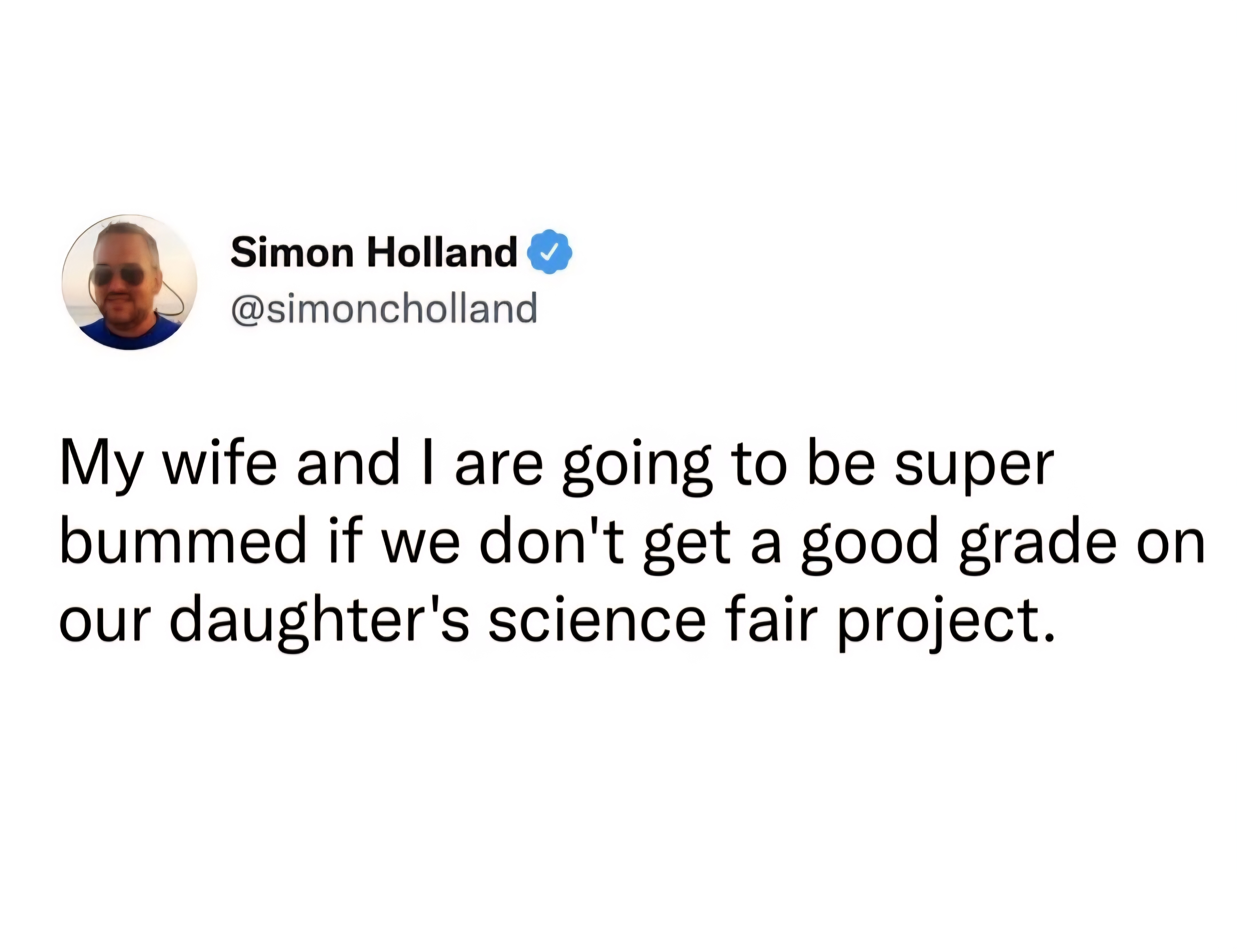
Would like to do a poll for how this works in other countries compared to the US. We already know the US has poor education system. Want to see why this kind of thing is seen as normal.
Swede here. I’ve only heard about things like this in american movies.
Most of us don’t have science fairs. We have a few projects in school, and that’s it.
In the Netherlands we don’t have this kind of thing. I don’t know at what age you have a science fair? At age 4-12 you don’t really have stuff you don’t really have homework, except if you’re lagging behind with your work. So all activities will be done at the school, sometimes they ask a parent to help with extracurricular activities. We don’t really have a science fair. Closest thing would be a “spreekbeurt” which would translate as oral presentation. You pick a topic you like and explain what it’s about. I think many parents help with the preparation for that. But you would have trouble answering the questions if your parents did everything.
At age 12-17 you get more beta courses, chemistry, physics, geography. You can pick a track that best suits your interests/aptitude. They focus on economics, social studies and art, nature and health or nature and technology. You get advanced courses that fit that track and more entry level courses for the rest. In your last year you have to write a paper with some field research on a topic that fits your track. Still not really like a science fair though.
That sounds perfect. I wish good grades could exempt us from homework in the US. But if we don’t burden children with long hours of unnecessary busy work, how else will we condition them to accept jobs that demand the same thing? /s
My daughter’s school did something similar. It was a project about future city development, where groups of kids could create their own visions of what the harbour in the city should be like.
Some went sciency and made robotic models and programmed led-strips and such, but most just painted the sides of cardboard boxes as a restaurant and printed a menu card, focusing on the business aspects.
The school then invited parents and the city council to come see the presentations and to vote on the best project.
They did all the work in school hours, so it’s not like the parents could assist if they wanted to. Of course some kids could potentially ask their parents for funding for expensive robots but I don’t think anyone did or what the point would be. It wasn’t a graded project and the winners got a bag of candy, so it’s hardly worth cheating for.
How many dioramas do you create in an average year