According to Wikipedia this planet has an estimated surface gravity of 12.43 m/s^2 with a margin of error of about 2 m/s^2. That’s only up to 50% higher than Earth’s 9.8 m/s^2 (on the high end of the error margin) so it probably would be possible to get into orbit.
That said we don’t actually know much about it for sure. We don’t know if it’s a terrestrial planet for example. It could be composed mostly of gases and liquids like Neptune.
(Not a rocket scientist or mathematician, but I spent 100s of hours playing KSP RP-1)
Just doing some estimates using data from the wikipedia page:
The dV (delta-V) needed to get into low Earth orbit is around 9.4km/s.
The dV for K2-18b might be around 19km/s, more than double that of Earth’s.It’s practically impossible I think, you would need such a massive launch vehicle. For double the dV, you would need exponentially more fuel assuming current rocketry tech (fuel+oxidizer tanks and engines). There wouldn’t be any single-stage or two-stage rockets that could do this. With a 3 or 4 stage rocket maybe? But you would be sending nearly 100% fuel off the launchpad with virtually zero payload.
Check out the “tyranny of the rocket equation”. The more propellant you need to lift heavier rockets, the more propellant you need to lift that extra propellant and so on and so on.
I tried to factor in:
spoiler
- Atmospheric drag - K2-18b’s atmosphere is quite dense with a huge radius:
The density of K2-18b is about 2.67+0.52/−0.47 g/cm3—intermediate between that of Earth and Neptune—implying that the planet has a hydrogen-rich envelope. […] Atmosphere makes up at most 6.2% of the planet’s mass
-
Since the atmosphere is so thick and takes up a lot of mass, I’ve picked 500km as the low orbit altitude (comparing to Earth’s ~100km Karman line, it makes you appreciate how thin our atmosphere is ).
-
Rotational assist - I’m assuming it’s tidally locked since it orbits so closely to its star (33 day years), and so you wouldn’t get the assist from rotation like you do on Earth:
The planet is most likely tidally locked to the star, although considering its orbital eccentricity, a spin-orbit resonance like Mercury is also possible.
Kerbal Space Program is such an amazing game that secretly teaches you physics.
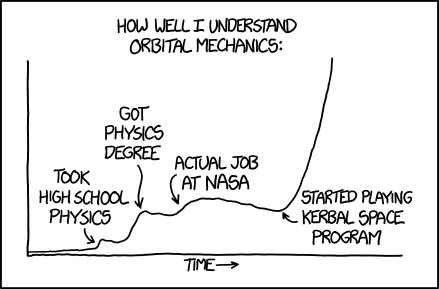
game that secretly teaches you physics.
those are the best!
I’m stealing this
Nice. It’s from XKCD if you want the source.
What about something like nuclear pulse propulsion, or some kind of massive spin launch?
Nuclear propulsion, like Project Orion, would probably make it more likely they’d manage to get out of orbit. No idea on the math here, tho
https://en.wikipedia.org/wiki/Project_Orion_(nuclear_propulsion)
yeah there’s also antimatter drives which give an even greater effective exhaust velocity (which is the speed of light). the highest possible achievable.
none have been built, so far
If it’s tidally locked, no spin assist.
Missed that part but that doesn’t preclude what I was saying, just requires “more” of it
Likely tidally locked
With a denser atmosphere, wouldn’t that mean that you could get more lift from a traditional aerofoil than on earth? And if so, wouldn’t that technically make it easier to start from a high enough altitude that at least some of the gravity is mitigated?
That’s what i was thinking - the dense atmosphere might even allow for platforms which are permanently suspended in the air like an inverse submarine, offsetting a large amount of needed fuel for a space launch
Let’s say you do the same on Earth. If you fly to the top of the atmosphere you are 100 km above the ground. That’s a 1/60 of the distance to the center of the Earth. You don’t have to fight air resistance but gravity is almost the same, if I’m not wrong, less than 1% of difference.
Yeah I realized that right after I made that comment. If the gravity is strong enough to hold a gas on the planet, it’ll definitely have a prominent effect on something denser like a solid.
Check out the “tyranny of the rocket equation”.
Or ask Randall Munroe How many model rocket engines would it take to launch a real rocket into space?
Build a large enough magnetic rail launcher and you could save shit tons of fuel. Get a ship doing 2000 mph before it leaves the ground and needs its rockets and you’ll have a pretty good head start.
Could even take a scramjet to the upper layers of the atmosphere before kicking in the chemical propulsion
I mean, that’s kinda still just adding on weight and another “stage” to the rocket. A scram jet hauling a rocket ship will use tons of fuel.
I thought scramjets were supposed to be really fuel-efficient? Just launch them with your gauss cannon idea so that they don’t need much fuel to get up to speed.
Maybe you’re right about the weight though. I’m not an engineer.
They’re efficient for what they are but think of it more like a gas pickup truck getting 30 mpg would be considered very efficient. But that would be terrible for a compact car.
Also, scram jets only get efficient once they’re going fast enough.
Yeah that’s why you do multi-stage like conventional jet -> ramjet -> scramjet
But again, yeah if it needs to carry a rocket then it might be unfeasible. We could try your gauss cannon idea, that sounds fun. Like a maglev train, but shaped like those rides from roller coaster tycoon where you could launch people to their deaths. Except instead of crashing, the rocket kicks on mid-flight. It could work.
You don’t have to launch from the ground, there are many things that can be done to allow them to reach orbit. It’ll be an enormously bigger undertaking but the physics doesn’t make it impossible. No reason to think of it in terms of our current situation either, and we are behind our current level of possibly when it comes to rocket science, due to * waves at everything else *
tidally locked
Wouldn’t that be a non starter for life? One side would be perpetually baked and the other would be frozen.
I guess there could be a planetary Goldilocks Zone in the dusk area
I figured that area would be full of extremely violent megastorms due to the heat differential.
Oh interesting that is a good point
Pretty late response, but if the atmosphere is that dense and hydrogen rich, you could reduce the start amount of fuel by a lot and capture it directly during flight? Needs some elaborated technology and low angle flight vector but could work, does it?
It’s probably still a lot harder though. You’re not just heavier, but also slower which means you’ll spend more time fighting gravity. And all the extra fuel you bring for that makes the rocket heavier which means you need even more fuel to launch the fuel. Higher surface gravity likely means a thicker atmosphere too which is a big issue and a more massive body also has a faster orbital velocity. Although in this case the larger diameter might counteract that a bit because higher orbits have slower velocities.
My point is that this would probably still be a lot harder than just building a 50% bigger rocket. If you’ve ever tried launching from Eve in Kerbal Space Program you know the pain. Although in that case you also have to fly the entire rocket there first which is its own challenge.
you’ll spend more time fighting gravity
Aw man. This is already a significant portion of my day.
It would actually be impossible for them to get to orbit using chemical rocketry, like we use. They could theoretically do it with nukes.
I’ve been wondering what a hypothetical perfect habitable planet for spacefaring would look like. Could you have one where a plane line the SR-71 Blackbird or an even less capable aircraft could simply “fly” into orbit? Or what about something Earth-like but with a flat plateau at 15,000 m where you could launch rockets from?
I think Mars, assuming you terraform it, would be pretty close to that on both counts. Space planes might still be difficult, but the delta V is much lower and Olympus Mons would pretty much sit above the atmosphere.
Holy shit, I hadn’t considered that you could use Olympus Mons as a launch site cause it sticks so high up.
The best part about it is that it’s an extremely gradual slope completely unlike the mountain ranges on Earth, so you could haul stuff up there on trucks or trains easily.
The problem is you can’t have mountains like that on tectonically active planets (a mountain that big on earth would sink into the mantle), which is kind of a prequisite for a long-term magnetosphere so its unfortunately not something a species could likely ever have except as a result of terraforming a world like mars and setting up some kind of artificial magnetosphere.
Is there a lower density limit for having a magnetosphere though? A habitable planet with 1.5x earth radius and the same mass would be much easier to get off of.
I guess that could work? Earth is actually the densest planet in the solar system so our baseline mass > size ratio might actually be a bit abnormal.
If that’s true, how did Olympus mons get there in the first place? I thought it was a volcano.
Mars was geologically active but its core cooled.
Classic planes require an atmosphere to generate lift. There’s an outer limit where that would be a viable mechanism, and on Earth it’s still far below LEO. Still too deep in the gravity well for ion thrusters to be viable. It requires chemical rocket fuels to bridge that gap.
Maybe someday fusion propulsion will break that limitations, but for now the best you can do is reduce the amount of fuel needed by flying to the upper atmosphere and reaching hypersonic speeds before kicking into rocket fuel propulsion.
Then after orbital injection, switching to ion thrusters to move around, and solar sails for exiting orbit into interplanetary/lunar routes.
Mars is better for launching rockets into deep space than Earth because it has a lower gravity field and also thinner atmosphere.
Orbital speeds would be very hard to reach compared to low Earth orbits. Also a much deeper gravity well to escape for travel.
I assume it’s not just about the gravity, but also the much larger radius of the planet would mean much larger distance from the surface, and thus much more fuel needed.
That’s not how…what???
F = G * (m1 * m2) / r^2
Note that radius is both squared and the dividing term. More distance = less gravity
Escape velocity does scale with (square root of) radius so its not a dumb thought.
And I’m not a rocket surgeon but I could imagine earth rockets might be operating near some physical limits that make a 50% increase (or whatever) infeasible.
Wikipedia says
energy = GMm/r.if
g=GM/r²thenenergy = mgr, proportional to r given g is constant.apologies
My previous comment was wrong, I derivated while integrating.
I stated an assumption and was contributing to the conversation. Even if that assumption is incorrect, there’s no need to be a dick about it.
It seems like a larger atmosphere would result in a longer duration exposed to atmospheric drag, thus requiring more fuel to overcome it.
deleted by creator
That’s, uh, not really how that works. A taller atmosphere would mean you have to go through more of it, but unless it’s not a terrestrial then the atmosphere won’t be that much taller.
If it is a non-terrestrial planet, it’s unlikely anyone would be building rockets on there to begin with.
If it has a higher gravity would the atmosphere technically be lower since it will squish up closer to the planet?
And your username would also be relevant.
You’re sort of right. The change in distance from the surface is insignificant, but a spacecraft orbiting a bigger planet has to travel further with each orbit so its speed must be faster to avoid falling out of orbit, even if the gravitational acceleration at its orbital height is the same.
Or Uranus.
Or your mother’s.
Imagine a terrestrial planet that is Earthlike in all respects, but it simply has more persistent cloud cover, such that seeing an open cloudless sky is miraculously unlikely, as unlikely as humans directly witnessing an asteroid impact.
No ground based astronomy.
No technological discoveries or culture that derives from ground based astronomy.
No celestial navigation on the ground.
Very different / stunted / more difficult cartography.
Technological civilization is capable of emerging, but it would not be able to well understand anything beyond the terra firma, not untill it generated aircraft capable of breaching the cloud cover layer, and then developed airborne observatories.
Have you read Hitchhiker’s Guide to the Galaxy?
Yea but they were playing cricket with the Galaxy
Hah, actually no I have not.
-1 nerd point lol
Don’t want to spoil anything because you really should, but this is very reminiscent of a plot point in one of the books.
Damn, only now did I realize I’ve only read one book in a series
deleted by creator
This hoopy frood really knows where the towel is.
Good news: it’s all public domain (edit: it isn’t). Whole series is there, at least the public domain ones. There was a newer one that wasn’t public domain when I last checked, though that was a long time ago and it might be now.
Don’t read it for nerd points. Read it to find out why it’s associated with nerd points.
Edit: disregard above, no idea where I got that idea from, maybe from how easy it is to find the full novel online just by doing a search for it, I must have figured and then somehow along the way it turned into a fact in my mind.
Uhh, I couldn’t see anywhere that it’s in the public domain. Could you point me to a source for that?
Turns out I just made that up, no idea where it came from at least.
Ahem.
https://archive.org/details/the-hitch-hikers-guide-to-the-galaxy-read-by-stephen-moore_202302
Not the PDF, but, also not not the book, technically.
Series? More then one? So long and thanks for all the books!
the universe’s only 5 part trilogy!
Have you read the short story “All Summer in a Day”?
I wrote and tried publishing a short story about a species like that.
where only occasionally people on top of mountains see stars, and they chuck it as a consequence of low pressure. eventually they invented flight, and assume pilots going high enough to see stars are having cognitive issues due to lack of air.
They asked pilots to draw the stars they see, and they get different drawings (they sent pilots at different times of the year because they couldn’t ever expect stars to shift) and assume its proof that thise stars are a cognitive artifact.
Eventually a pilot swears they are real and can actually use then to navigate, skepticism, he proves it. brand new research field emerges.
Although the story focuses more on deep DEEP time an omniengineering. (A term I just made up because mega engineering is a concept way too small compared to the one in the story).
If you want I don’t mind putting that story in the conversation.
Post it for sure
https://docs.google.com/document/d/1PTzQQKXLnBL1ICUK8IYa8YoUSD2ncQk5-jse-FaFPAI/edit?usp=drivesdk
tried putting the text in a comment, but it’s too long, I enabled comments.
I loved it. Thanks for sharing!
Given who you are, it means a lot.
That was a good read! I liked the pacing, the dawning not quite horror.
I liked it. It seems to fall apart at the end a bit but this is a really cool concept for sure.
if you don’t mind. could you elaborate? it’s ok if you don’t, I am rudely asking for free labor.
Seems like you were going for a bit of a twist ending where the letter is actually a threat. It didn’t really land for me.
The threat could be more concise and pointed which would give it more impact. Instead of speculating about how humans may react and then saying the aliens will counter it, maybe just say something that amounts to “resistance is futile”.
Its also not exactly clear to me what “the problem” is. Its that their race will someday come to an end? There is a lot to be said about this idea and I think you should explore the philosophy of that more. How does prolonging their existence save them? Seems to me like they’re still left with the inevitable.
the problem is the inevitability of the heat death of the universe, and the meaningless of existence if there’s no life at the end.
While the solution is to optimize the entire universe, though massive galactic engineering (using plausible physics) to maximize their research in order to break thermodynamics. I’ll try to make it clearer.
the ending is clear, but wether it’s good or bad is ambiguous and up to the reader, as they basically incarcerated humanity on earth and took away any possibility of humanity ever leaving earth. without any negative effects on the planet or humans.
Shit yeah go for it, I love those kinds of stories!
https://docs.google.com/document/d/1PTzQQKXLnBL1ICUK8IYa8YoUSD2ncQk5-jse-FaFPAI/edit?usp=drivesdk
tried putting the text in a comment, but it’s too long, I enabled comments.
thank u, good read
I’d read it
https://docs.google.com/document/d/1PTzQQKXLnBL1ICUK8IYa8YoUSD2ncQk5-jse-FaFPAI/edit?usp=drivesdk
tried putting the text in a comment, but it’s too long, I enabled comments.
Heck yeah, I’d read that. Feels like it could have been a Hal Clement story idea.
https://docs.google.com/document/d/1PTzQQKXLnBL1ICUK8IYa8YoUSD2ncQk5-jse-FaFPAI/edit?usp=drivesdk
tried putting the text in a comment, but it’s too long, I enabled comments.
Thanks! Will review.
no pressure. and be honest, if some parts are shite tell me. and especially if it is all shite.
“Nightfall”, by Arthur C. Clarke is a short story based on this premise.
Except in the story it’s a complex multiple-star solar system that makes it very rare for all suns to set at once.
Edit: It’s actually Isaac Asimov.
Augh!
You’re telling me there’s an Arthur C Clarke short that I missed?
Damnit I am losing so many nerd points today.
It’s an Isaac Asimov story. An excellent one I cite frequently with regards to human ability to cope with increasing rate of change.
Whoops! That’s my mistake.
points regained, even doubled!
thanks for the good read!
Well, the church threw us back about a millenia, so what’s a few centuries.
Is there a particular instance you’re referring to here? Because contrary to popular belief, the church has historically been big on investing in what we now call science.
For instance, although the trial of Galileo is often characterised as “big bad church holds us back because religion is opposed to heliocentrism”, there was actually a lot of legitimate scientific beef against Galileo. Although he ended up being right about heliocentrism, he didn’t really have good evidence to support his claims; He didn’t understand Kepler’s laws of planetary motion, and his telescope produced so many aberrant artifacts that astronomers who use it were reasonable to be dubious of his claims.
If you’d like to learn more, here’s an excellent video by Dr Fatima, an astrophysicist turned science communicator. The philosopher of science, Paul Feyerabend also uses Galileo as a case study in his book Against Method
Because religion contradicts scientific approach to thinking. I personally like the way in which Carl Sagan gets rid of all the “noise” information when investigating how the world works. Religion is a noise
If you’re a fan of Sagan, you might be interested to hear that he considered that “science is not only compatible with spirituality; it is a profound source of spirituality”.
Religion might be noise for you, but for countless people across history, it has been what has helped them to cut through noise. Religion unequivocally does not contradict scientific thinking — what we understand as scientific thinking wouldn’t even exist today if not for religion.
Things don’t have to be a binary of religion vs science. Religion has so often been the driving inspiration for brilliant scientists across the world, for much of recorded history. And in parallel, there have been religious scholars who find spiritual awe and fulfillment in seeing scientific advances.
That definitely doesn’t mean that everything is always great between religion and science — I’m very much not a fan of things like evangelical Christians who claim that dinosaurs weren’t real, or the Taliban who prevent women from being educated. Those are examples of religion being used as a cudgel against science, but if we want to genuinely resist that kind of thing, it’s not productive to instead try to use science to bash religion. Our best resistance is to embrace the fact that science and religion can and do coexist, in many different shapes and forms.
Part of my stance here is pragmatic — I’m a scientist myself, and I am filled with dread when I see how anti-science rhetoric is flourishing nowadays, and I am resentful as hell towards the many religious assholes who are feeding that. However, if I direct my beef towards religion as a whole, then that’s a heckton of people that I’ve given up on trying to convince. I believe that the scientific method should be a tool that everyone has available in their toolbox, even if it’s not something their daily life often requires — it’s a useful perspective to have on hand no matter your background.
However, I’m realistically never going to convince someone to give up their faith in exchange for this tool, especially as I am not religious myself and thus don’t properly understand what purpose religion serves them. I can make a far more compelling case for science if it isn’t framed as something that seeks to displace their faith. And you never know, once someone does have scientific thinking as a tool in their toolbox, and they know how to use it, they might end up relying on it more and more. I personally know many scientists who have experienced this kind of journey. Though giving up on faith entirely isn’t required, as evidenced by the many excellent scientists I have known whose religious faith drives their passion for research — the best biochemistry tutor I ever had was even a reverend.
Science and religion are not incompatible, and there is evidence of that strewn across history and society. To ignore that fact would be to betray the principles of empiricism that the scientific method is built upon.
Yes I am well aware that he advocated against religion but was pro spirituality.
The thing about religion and science is - religious scientists believe that absurd things in religious books are just a metaphysical explanation, though if you read it you just can not give a second meaning to it. Or they believe that god and his books exists outside of logical explanation. There are lots of religious people who practiced science and made their contribution. If mistakes like that exist in such a book of “extraordinary claims”, with some shallow but definitely not “extraordinary evidences”, that is just an “intellectual mistake” to believe it.
We already know that ppl despite all the intellect will be prone to believe what they were programmed for in their young age.
Because religion contradicts scientific approach to thinking
Any scientific base for that claim? Because there seems to be way to much religious scientist for it to be true.
deleted by creator
Pick a religous war. then pick another. Then knock all the rest of the religous wars into your shopping cart. Now consider future religous wars.
We’re talking about science not wars here.
Also wars are one of the Strongest advancer of science, case in point: jet engine
Project Hail Mary has a bit about this, don’t want to say more to keep it spoiler free.
Haven’t seen it yet, I appreciate the nonspoiling =D
iirc that detail they are refering to, didnt make it into the movie.
Yes, correct, they skipped a lot of the harder science for the movie to keep it a reasonable length. Movie was still very good though!
yes. both are good in their own. It’s definitely worth to both watch the movie, and also read the book.
Definitely read the book. The book is about the existential elation at discovering a solution to a dire problem, so knowing a poorly-communicated version of every solution will likely ruin the book for anyone serious about the hard Sci-Fi.
Well, as soon as they invent radio and experience interferens radio astronomi will evolve… I guess?
This is a Doctor Who Christmas Episode
I have written a post about exactly this phenomenon, arguing that that’s how most animals/insects see the world (assuming their sense of vision isn’t good enough or they just don’t care to look up). Apparently i was wrong, even insects can see the stars and navigate due to their light (milky way navigation).
I would instantly buy your book!
Hah, I haven’t written one, but maybe check out Arthur’s short story elsewhere in the comments!
He’s got uh… watermelon emojis in his name.
That just sounds like a hollow world…
Wouldn’t those people want to see above the clouds? When they invent flight they’ll see above the clouds and might want to get higher
Jokes on us: Because of the gravity issue, alien life on such planets jumps right to stargate technology.
“They spent almost a thousand years fooling around with rockets!”
Uhh, one stargate doesn’t go anywhere.
You can accelerate it into space at g forces which would liquify living beings, perhaps?
Using what?
(Remember the premise of this subthread is that they’re doing this instead of rockets.)
Bah, Stargates are just propaganda from the rocket first civs.
There is no need to send a gate in advance, just use your favorite teleportation mechanic.
I’d say they stand a whelks chance in a supernova of that succeeding.
Actually I’m a marine astrobiologist and that chance is really really high
Just frisbee those things in random directions until one works.
that’s why you communicate via radio waves to other life in the area and build a network
Waddayamean a « ro-ket »? You guys don’t use the three seashells system for liftoff?
Haha he doesn’t know how to use the three sea shells.
If the planet is massive enough, getting to orbit becomes a real challenge because fuel consumption scales roughly exponentially with the mass of a planet (delta-v formula, rocket equation).
This leads to an almost sharp cut-off for the maximum mass that a planet can have so that a rocket which utilizes chemical fuel (e.g. methane+oxygen) can still reach orbit successfully. This maximum mass is roughly 10^26 kg.
For reference: Earth’s mass is around 6*10^24 kg.
While other propulsion types exist, such as nuclear + ion drive, these propulsion types are significantly more complicated.
Interestingly, if a planet is too small, it cannot hold an atmosphere. There is a surprisingly sharp cut-off minimum mass for this as well, at roughly 10^21 kg.
We really are in the Goldilocks Zone, aren’t we?
Well, yes. In the middle of the goldilocks zone that is based on the environment we are adapted to is where you would expect to find us :p
Haha fair point.
Anthropic principle ftw
Only if there are not sentient life forms on that planet capable of getting off it
If anything, it’d be a bias towards spaceplane designs over straight up rockets. As long as the atmospheric density relative to the gravity supports it, offloading some of the acceleration to high atmospheric flight using ram/scramjets can massively reduce the launch vehicle mass (don’t need to carry oxidisers for the flight stage).
That being said, it also would be a bias against high orbits and space exploration in general; safe re-entry is tricky enough on earth.
What if, and hear me out… Giant trebuchet?
I propose going to the south pole and just letting go??
I suspect that atmosphere composition makes different options more or less viable.
The difficulty/cost getting to orbit probably also would influence where a space elevator lands in terms of developmental priority.
I did not know that. It’s because it interferes with gravity? I’m dumb sorry
Not enough gravity, the atmosphere will drift away from the planet with the help of solar winds etc. Too much gravity, and the ammount of fuel you need to leave the plannet weighs more than the rocket the fuel is being used to lift can carry.
Even in our current ships, most of the fuel used to leave orbit is really used to carry the other fuel you need later.
That’s interesting! Thank you!!
I assume the amount of energy required for ‘only’ 50% more is massive.
Apparently with 50% higher gravity it would be pretty much impossible with chemical rockets, but with the median of the estimate (so about 12.43 m/s2) it would be possible, you’d just need an incredibly large rocket, or non-chemical propulsion (e.g. nuclear).
A space program on that planet would definitely advance much slower than on Earth.
How well funded have our space programs been? Maybe they aren’t diverting massive portions of their resources to war and can actually focus on space.
They were well funded back when their real goal was to develop ICBMs capable of delivering nukes.
I get what you are saying, but the Saturn V was never intended to be an ICBM. Depending on what numbers you look at too, they weren’t actually that well funded. Some of the largest estimates that I’ve seen place NASA’s inflation adjusted budget between 1960 and 1973 at just under $600 billion. Or roughly half of what we’re spending in one year on the military currently.
To put it another way, at its absolute peak budget NASA received roughly 4.6% of the current military budget.
Also to launch big spy satellites into orbit.
Iirc near that +50% level you end up needing a saturn 5 to launch sputnik, so its more expensive to the degree that it might just be deamed unfeasable, at least at the technology level humans started launching rockets at.
Much slower as in hundreds or thousands of years, so practically no difference at all.
Also i wonder since the diameter is larger, is this effectively like putting everything in a higher orbit which is also more difficult then if it was just twice as dense.
That really depends on the atmosphere. The lower the orbit the easier, but if you have too much drag from the atmosphere, you ain’t staying on that orbit easily
The tallest people on that planet

I’ve been wondering this for years now. Sci fi and even actual scientific speculation tends to assume aliens would be way ahead of us in terms of technology because their planets may have been formed earlier. I don’t think time alone matters. If they don’t have resources, if fhey don’t evolve the same way, if they have more difficulties in doing shit due to any number of reasons… They could be far less advanced than us. Maybe nobody in the entire universe has figured out how to realistically travel between stars yet. Maybe we are the only ones who have even managed to get off our rock.
Imagine humanity in 1000 years. We would be among the stars.
Now imagine humanity in 10000 years, 100000 years or even 1000000 years.
A million years is still a fraction in the cosmic timescale.
It would be nearly impossible to have other civilizations be on exactly the same technological level as us. They would indeed be either much less advanced, or much more advanced.
With all the crazy ass things that can kill us off, I don’t think we’re alone in the universe, but we may very well be alone in time.
The Fermi Paradox might just the the likelyhood to get wiped out from motions to everything and we’re too far away to get contact in this gnat’s ass of a conscious timeline we’re in.
This is mostly uneducated postulation, but I think as we become more technologically advanced, technological advancements (and the knowledge of mechanics necessary to allow for them) become fewer and more far between as advancements occur.
I feel like the industrial revolution was a perfect storm of many advancements all happening in the same blip, and it allowed us to go from Wright to the moon in one lifespan, but 100 years later, we’re still not far from that point, technologically.
I mean, look at radiological half life - that’s the point at which there’s a 50% chance that any one atom will decay, but when that atom decays seems to be mere chance more than anything. It’s perplexing and maddening. But the more we stare at that, the more sure we are in the belief that the void, nothingness, is actually rife with energy just flitting in and out of perceivable existence, affecting observable particles, but we just can’t see this vacuum energy. Almost like quantum mechanics is used as a workaround to try to make sense of those unseen forces (and when we can observe them, it’d likely be able to be described in a more classical sense).
Maybe the industrial revolution gave us some hopium lol, but we’ve been butting our heads into a wall for a century pining for a magical microscope. Maybe in 500 years it’ll all look mostly the same, who knows
The last 75 years of nothing is because of Neoliberalism. It is not conventially profitable to spend government funds on scientific exploration. Government funds are used to counter tax breaks to the wealthy and corporations. Along with just stealing the money through various means.
I agree with you for the most part. We’ve seen companies with dominance just sit on innovation and basically slow play it when competition keeps up, or go straight to lawfare or popularity contests (Intel cough cough). Kinda sucks we place more importance on the resources used to arrive at innovation than the practicality of those innovations. But where we’re at now, it’s like peeling an onion and what everyone wants to find is 3 layers down, so it’s not like we can build more LHCs to smash particles, because the things we need to find are a couple skips past that point. We eventually find it, what next?
This is just arrogance.
We have only been announcing our intelligence for 100 years. It takes 100,000 years just to cross our galaxy. No-one knows we are here yet.
There’s also the Dark Forest hypothesis - the idea that maybe many alien civilizations exist out there but stay silent because revealing themselves would make them targets/prey to a more high-tech hostile civilization.
3 body problem is a good book for thought experiments, but it didn’t really discuss the arguments against the dark forest hypothesis
-
assumes universal hostility.
-
Interstellar warfare is protracted and impractical.
-
Ignores potential cooperation and ethical diversity.
-
assumes aliens think like humans
Regarding the first point, I think it just assumes the possibility for hostility, not the universality of it. If there’s a room with a thousand people and I know one person in the room has a gun and wants to kill me, I’m still going to hesitate to enter regardless of the 999.
Also, any intelligence that arises out of evolution is going to have at least the rough concept of violence.
Counterarguments
The 999 are going too overpower the violent 1.
The concept of peace will be known and experience will have demonstrated that it is more valuable than war.
Counter-counterarguments.
That assumes the 999 are in a position to stop the 1. Assuming FTL travel/communication/detection is never possible, reaction ability is always going to be limited. A relativistic projectile aimed at a planet can be a silent civilization killer.
This is more about cautiously reacting to the possibility of hostility in the very high stakes scenario of first contact, not the confirmation of hostility. In the room analogy, we don’t know who has the gun, whether it’s truly 1 person or 0 or 100 or 500, if most or all of the 999 are blindfolded or willing to defend newcomers, whether overpowering the violent one(s) is actually possible due to everyone being spread out and any guns having functionally unlimited ammo, whether other people have already been taken out for just showing up or resisting, and whether all of the above even matters if the aggressor gets a kill shot off before any of the above takes effect.
Evolution is inherently a competition for limited resources with winners and losers, so violence innately comes with the territory. Even grass and trees are in a war for sunlight. The concept of peaceful cooperation may be common due to the individual specialization likely needed for a species to become space-fairing, but it’ll be a higher level, more abstract idea, and the universality of other species applying it more broadly cannot be assumed.
Yes. Those are the book’s arguments. A counter-counter argument is a repeat of the same argument.
-
I’d imagine any intelligent alien life form would be intelligent enough to realize that they’ve reached a point at which they can simply life in a sustained utopia. Heal the planet, work less, fill time with hobbies and pursuits. Humans have this flaw, and it’s that the mentally ill squander the world’s wealth and use it for dick-measuring contests. A small minority of us will kill their own mother for a job promotion, and the people at the very top want to squander it all so they see another 0 in their bank account, or outrace the other 7 megabillionaires to the dick-measuring contest on Mars. I could only hope aliens aren’t as as stupid. We could just litter the earth with trees, solar panels, 2 br condos, and hammocks, and have AI work for us, but nope. Every single die shrink leads to more transistor density and never any power efficiency because big numbers are better for shareholders. They sold us downstream. If any alien contacts us or leaves a trace they’re most likely just as dangerous to our survival as we are. Space conquistadors
It’s not convincing because it’s impossible to hide. You always produce waste heat which would be visible (if you use 100W of solar power, you dissipate 100W in deep infra red into space)
We would expect to see stars putting out an amount of energy for a bright star, but in deep IR as they’re wrapped in Dyson spheres or swarms
if you use 100W of solar power, you dissipate 100W in deep infra red into space
If you have a sun nearby then will someone notice the lag?
I don’t think you could exhaust the waste heat of a civilisation in a black hole. Perhaps a civilisation living in computers could, but not a biological one
Maybe we aren’t the first, maybe we aren’t the last. What if there is other intelligent life on other planets, but just because of the distance their signals have not managed to come to us and our signals haven’t managed to get to them yet. That should be fairly possible simply because of the how big the universe is right?
Maybe they just don’t want to leave their planet because it’s dope af
Some humans want to travel even when they’re perfectly happy.
That’s ascribing human motivations to non-humans. They could be fundamentally non-curious, only using their relative intelligence to solve actual problems in their environment rather than pushing for “what if?”.
If you have a species that doesn’t feel a drive to explore they would never leave the place they evolved, then they would be at high risk of extinction when their climate changed with plate tectonics
And perhaps it’s the drive to explore that has humans exploring ideas
Maybe you need to be like us to get into space
Most people don’t feel the need to kill someone, but if their life depended on it, they’d kill in self-defense.
You’re conflating the “need” with the “ability”.
I wasn’t talking about need or ability, only exposing themselves to extra risk, failing to discover important discoveries because they don’t explore ideas. I’m sure I wasn’t perfectly clear.
This argument has never really made sense to me. If you picked a random individual lifeform from anywhere in the universe, then yes, there’s a good chance it won’t have much in common with humans. If you take the totality of all life in the universe however, we should see a smoother distribution of behaviors. Human-like behaviors would be within that spectrum by definition and should not be entirely unique.
Let’s say of all the intelligent species in the universe, an average of 1% exhibit whatever motivations are needed to go interstellar, and that 1% of those species got a billion year headstart. Well, due to sampling bias, we should still see that 0.01% represented everywhere.
I was flummoxed for a while because it sounds like this isn’t even related to what I was saying. Until it clicked that it wasn’t.
I only said to be wary of anthropomorphizing non-human creatures. Saying all life explores is assigning the human definition of “going out and charting the uncharted” to all of the exploration that any creature that actually explores does. Other interstellar species could go into space for perfectly practical reasons, like their planet is dying or it’s over capacity and they don’t want to cull their population. Assigning “human wanderlust” as a facet of all (intelligent) life isn’t correct.
Sorry. I may be reading more into the chain than what’s actually here. I’m just saying “aliens can’t be expected to behave like humans” isn’t really a viable explanation to the Fermi Paradox without some big caveats, because given a large enough sample of intelligent alien species, (1) they won’t be monolithic, (2) some will exhibit human-like behavior on the premise that humans aren’t special, (3) some will have arrived on the scene millions or billions of years before us, and (4) the “somes” from the last two points is enough that galaxy spanning civilizations should already be everywhere even if FTL is forever impossible.
If intelligent life is rare enough to preclude the “given a large enough sample” (I’m thinking one species per galaxy level rarity), then the solution to the Fermi Paradox is elsewhere.
Um. The desire to explore is pretty innate to all life. Not just humans.
How much “exploring” do sedentary lifeforms (plants, mussels, etc) really get up to?
https://en.wikipedia.org/wiki/Dorsal_root_ganglion
Bivalves such as mussels are aware of many stimuli but are generally incapable of safely relocating making them one of the incredibly few exceptions to the rule.
I would generally assume any alien lifeform we encounter would be closer to humans than bivalves.
There still is the „Early Bird Theory“.
When you look at us, the Earth, life has formed almost immediately after the conditions where given. On top of that the universe itself isn’t even that old. There is a good chance, that Fermi was right but we are just the first ones.
… which makes me think that whatever or whoever designed us had some work left to do. You left in some bugs buddy.
There’s also a theory that we’re too late, and that our existence is like the remaining microbes in a puddle of water in a desert.
The universe used to be lukewarm with conditions for life to exist everywhere, until it expanded and started cooling.
On a positive note, this could also mean that life lies dormant everywhere just waiting for the right conditions, so that anywhere that has the right conditions also has life.
IMO it is more likely that we’re more early than late (though an argument can be made that there’s a sweet spot in between the two).
When the universe was lukewarm, I don’t think the conditions existed for life to exist everywhere because there hadn’t been enough stellar nucleosynthesis for there to be astrophysical metals (i.e. anything heavier than helium, with the possible exception of lithium at a very low concentration). Not much useful chemistry can be done with just hydrogen and hellium.
Additionally, planetary systems surrounding earlier generation stars are much rarer than those of the same class at the Sun. Planets that formed around earlier generation stars did not have access to a high enough variety of astrophysical metals to create the complex chemistries that chemical life requires and their host stars were likely too short lived to make advanced evolution possible, even if they had planetary systems.
Planets formed around stars younger than/with higher metallicity are much more likely to be gas giants that would have their own set of issues with the evolution of chemical life (e.g. much lower carbon presence).
The “optimal” time frame for the development of complex life on a planet would theoretically vary by its position compared to the galactic bulge its star formed in, i.e. earlier closer to the galactic center and later further out. Being closer to galactic core makes for a higher chance of being blasted by a supernova or other extremely high energy astronomical event, making for a higher chance of mass extinctions.
If most stars/planets formed much before our sun lacked sufficiently complex chemistry, and those formed much after it lack sufficient carbon and provide a host of gravitational/pressure issues that would inhibit technological development even if evolutionary life did arise, it seems likely that most planets potentially with advanced civilizations are of similar ages. With some slightly older examples nearer the galactic core and some slightly younger ones deeper into the spiral arms.
Well said, this is what really gets me wondering just how astronomically (heh) lucky humanity is. I think the by far best argument for the Early Bird hypothesis is our status as a third generation system, in a relatively safe position in the galaxy, on a planet with the right amount of gravity, with a moon and gas giant asteroid shield, with a Goldilocks zone, with a fossil fuel reserve which required the right cascade of environmental disasters and evolutionary progress, etc etc etc.
Life seems to arise very easily, but the circumstances you need to build a space ship don’t.
Eh, I don’t buy it.
Humans are proof that life is still possible in our universe. How could all life have died out when life is still perfectly possible?
Only way this is possible is if life didn’t adapt (which I don’t see life doing).
There is a good chance…
Probabilistically, the early bird theory is unlikely. If development of life were to follow a normal distribution, it’d be highly improbable that we’d be in the tails as opposed to the main body.
I wonder what another being would need of us if it was already able to travel through the vacuum of space while self-sustaining. We’re basically doing that right now anyway.
They’d want our coconuts, I bet. They’re pretty cool, I bet aliens don’t have coconuts. They might have some cool alien fruit to trade for coconuts. Or weed.
alien pointing at a coconut tree
Look, m’lord! Horses!
Coconuts are mammals
Poetry, fashion, art, exotic pets.
Larry Niven and Jerry Pournelle’s Footfall had that as a plot point. The youth of the alien invaders who were born on the ship and had never lived on a planet disagreed with the others about invading Earth as the stuff they need can more easily be found on Saturn’s moons
The interesting thing about this is that it could be a double whammy. The collision that formed the Moon not only made Earth smaller, it also ejected a lot of material away from the orbit. This made Earth even smaller than it would otherwise have been, had the two bodies merged. And the Moon also formed in the process. The Moon causes the tides which are theorized to have a significant beneficial effect on evolving more complex forms of life.
So just being small might not be enough and having a big moon might also not be enough, but Earth was lucky enough to have both. And that’s just some of the things in a long list of things that have to go right to get complex life on a planet.
My feeling is that life is pretty rare, but given there are so many star systems in our galaxy there might be a lot of it still. But most of it is probably very simple stuff. Getting to where Earth is, might be a once every couple of millions of years event within our entire galaxy. So there really might be nothing intelligent out there at this moment in time, there might have been earlier and there might be in the future, but for right now we are it.
Yup, I wonder sometimes, all those sci-fi tales about a long lost ancient civilisation that spread throughout the galaxy before everyone else did, what if we’re set to become that, before space-faring life eventually emerges, then thrives and flourishes all over the galaxy?
One can dream anyway…
What gets me are the people that insist that humans can’t be exceptional and be the first civilization in the galaxy because we’re really dumb… which is it’s own exceptionalism.
If you really thing humans are ‘meh’, the solution to the Fermi Paradox that fits best is that we’re lucky and among the first civilizations. Especially when you consider that the universe hasn’t been hospitable to life until very recently
Try Revelation Space by Alastair Reynolds, the whole series is great.
Oh, thanks, will do!!
Fun fact worth noting: humans and octopodes split back when our shared bodyplan was effectively a worm who just got legs. Octopuses have been shown to be able to learn and memorize letters, patterns, their different keepers (e.g., spitting at one particular keeper they didn’t like), etc., and all the intelligence they’ve been demonstrated to learn evolved separately from humans.
So we’ve actually got two examples of “worm with newly-evolved legs” becoming pretty damn smart on Earth, not just one - which makes my bet more on the “if the biosphere got to worms with legs, there’s a lot of smart stuff there”
I hear a biologist once say that if the octopus could live to be 80 like humans, they would be in charge of the planet instead of humans.
The main disadvantage octopi have is their antisocial behavior. The parents don’t raise and teach their young. They live in solitude. The only time they spent time together is for mating, after which they die.
Octopuses that can talk to each other, hunt in groups, and raise their young collectively would be pretty formidable. Even if they managed to get there, they would still be living underwater making the use of fire pretty difficult.
Children of Ruin is a great book that describes a civilization of octopus, if you want to explore this a bit.
deleted by creator
Wow I had to look up their lifespan because I thought they were theoretically immortal (it was a jellyfish i was thinking of). Only 5 years and octopus can be this smart? The psychotic hairless apes got off easy this time.
And that’s just some of the things in a long list of things that have to go right to get complex life on a planet.
There’s ground bacteria that adapted to live in human-made tar lakes, digesting tar instead of straw.
Imagine all the room for activities! (Trench warfare)
Maybe it was “”“too easy”“” for us to get to space so that chemical propulsion was good enough. Who knows where we would be if that wasn’t the case.
i’ll tell you where. we’d be eating empanadas and drinking coffee at the good cuban place that bought the yellow shack restaurant that i’ve been trying to buy for 20 years.
damn good empanadas.
We make a mistake by assuming that life forms would likely be at the same scale as us. Larger planets would likely develop life forms appropriate for those planets instead of appropriate for ours.
Most of the life we see on Earth isn’t even our size!
Life on earth scales from microscopic bacteria all the way up funguses that have an underground network covering thousands of acres.
The chances of us finding life on another planet is pretty slim, the chance of that life looking like us is astronomically miniscule.
Also, of all the millions of species that have evolved on Earth, only one has developed civilisation. We’re an anomaly, not an inevitability. Other planets could be teeming with life, but it’s happy to just chill in the forest/ocean/wherever.
That’s just blatantly incorrect.
Humanity believes that it has the ability to estimate the intelligence of other animals.
And the way that it does so is always by measuring how well the other species imitate human behaviors.
It doesn’t take into account whether those other animals care to imitate human behavior or whether they know they’re imitating human behavior or whether they want to imitate human behavior. And it most certainly doesn’t understand how well those other animals’ intelligence applies within their own niches. You can’t test animals’ intelligence by testing how closely they behave to human beings when operating mimicking human niches and human goals.
Speaking as someone who’s autistic, I’ve done the research on that. In autistic people, there seem to be a higher number of certain specific neanderthal genes. I’m also very gifted, and work in STEM.
Neurotypical human beings are BLOODY TERRIBLE at recognizing any type of intelligence that is different than neurotypical human beings. It is ASTOUNDING how bad they are at it.
Neurotypical people can’t even recognize the intelligence of autistic people. And good luck determining our goals. Other people think I am stupid when they first interact with me, but that couldn’t be farther from the truth. I’ll just say that revealing too much here would reveal my identity, and I’m not going to do that, but I have a list of accomplishments that I literally couldn’t imagine most neurotypical people accomplishing, and I know many other autistic people who are very intelligent. Does this discount neurotypical intelligence? No, not in the least, and it’s not intended to. But it does demonstrate that Fermi’s Law could be nothing more than humanity’s inability to identify other forms of intelligence. And hell, whether you even consider autistic people to be a different kind of intelligence, that’s not even referencing animals.
What neurotypical humanity HAS developed is not the only civilization, but the only widespread manipulation of the environment in ways that significantly distorted the environment in such a way that their presence was undeniable long after an absence. That’s not the same thing.
Uh… being smaller or larger does not really change the laws of physics… if the gravity is too high, no fuel has enough energy density to escape the gravity of the celestial body.
If you need 150kg of fuel to get 100kg worth of matter to escape velocity it does not matter how much fuel you have. It will not ever be enough to leave.
I love how Earthlings assume that all of the variables on other planets would be exactly the same as they are on Earth, leading them to believe they have any idea about what other species might be dealing with on other planets.
It’s cute.
You do know that they couldn’t even estimate the functionality of the heat shield of the spacecraft that just splashed down on our own planet? That they had to literally increase the angle of entry because they couldn’t accurately predict the behavior of a craft on a planet that they’ve been studying for all of recorded time?
Are the laws of physics actually a thing? Clearly. But here’s the thing: The kinds of organisms that might exist on such an object could be absolutely massive compared to us. And for us to assume that we would have an understanding of the laws of physics that would be anywhere near as great as animals that might have brains exponentially larger than ours? And hell, the energy that might be available in such environments? We don’t know what’s in space around these objects, or whether there are any kinds of characteristics which would make unconventional (to us) means feasible to get off of the planet.
For all we know, they could be scientifically a billion years ahead of us and might be able to manipulate time or matter in ways we couldn’t conceive. It hasn’t even been 100 years since humanity learned to harness nuclear power.
No, there are too many variables. Life on such planets could evolve in countless different ways, and the different characteristics of the environment, and the resources on and around the planet provide too many options for us to be wrong.
And before you respond that I am arguing against science, no, it’s actually your opinion that is arguing against science. History is filled with organisms finding unusual solutions for problems that were long deemed impossible to solve. And when people said “Well, I don’t think we have enough knowledge to make such a firm claim,” history is also full of people like you who insisted that there was no way. And history is full of people who walked into the room, picked up the rules as they wrre known to that point, and basically flipped over the game board.
You are literally the person arguing that a scientific process is impossible given environmental variables because they don’t match the laws of physics.
But you don’t understand that you are arguing not for the infallibility of those laws, but for the infallibility of our understanding:
-
of the laws as we understand them
-
of the chemical makeup and geography and resources of the planet
And all of that is not even to mention that the estimates of whether the planet itself was capable of supporting life have literally changed relatively recently because humanity developed a better understanding of science.
If I had a nickel for every time someone proudly claimed something to be impossible because it hadn’t scientifically been done yet I would be richer than Elon Musk.
Unlikely? Well, look. I’m not willing to make statements about humans’ accuracy when studying objects that far away. I will acknowledge that it’s not something that would be easy for us to accomplish given our current knowledge, but my humility can acknowledge that that seems to say more about US on this planet than it says about any kind of organism that may have developed on such a planet.
You’re treating scientific uncertainty as if it means “anything is possible.” It doesn’t.
We don’t assume variables on other planets match Earth. Astrobiology, planetary science, and exoplanet studies are built on the opposite assumption: that most planets don’t resemble Earth. When scientists estimate what life or civilizations could be like elsewhere, they work from measurable constraints (gravity, density, stellar flux, atmospheric composition), not wishful thinking. For example, we know that: A planet with 3× Earth’s gravity constrains organism size, structural strength, locomotion, and escape velocity. A planet with a dense hydrogen atmosphere changes chemistry and energy availability. A star’s light spectrum dictates photosynthetic possibilities. These aren’t guesses. They follow from basic physics and chemistry, which apply everywhere.
“They misestimated a heat shield” ≠ “we don’t understand planetary physics.” Engineering uncertainty in a single atmospheric re-entry doesn’t invalidate the underlying physics. Weather variation, material tolerance margins, and modeling limits don’t erase Newtonian mechanics or thermodynamics. If your argument were valid, airplanes would disprove gravity because turbulence is hard to predict. Scientific uncertainty does not mean lawlessness.
An organism the size of a mountain on a 10g world can’t simply evolve because “maybe their brains are bigger.” Biology cannot override: stress limits of matter metabolic scaling laws biomechanics gravity energy density limits An advanced species might innovate, but it doesn’t get to ignore basic constraints. A billion-year-old civilization would know more than we do, but they still can’t accelerate to escape velocity without energy, or support infinite mass with finite-strength materials. Knowledge does not nullify physics.
For all we know, they could be scientifically a billion years ahead of us and might be able to manipulate time or matter in ways we couldn’t conceive
This is pretty much just “We can’t rule out magic, therefore you’re wrong. Science can only operate on what’s known to be possible or what follows from tested theories. Speculating about physics-breaking abilities isn’t meaningful without evidence; it’s equivalent to saying “you can’t disprove dragons.”
When scientists say “a civilization on a super-Earth would struggle to reach orbit,” they base it on: the planet’s mass and radius → calculates escape velocity atmospheric density gravitational load on structures realistic energy sources We don’t need to know the exact geology to know that a planet of a given mass requires a minimum amount of energy to launch mass into space. That’s just conservation of energy.
Saying “we don’t know everything” is true. Saying “therefore any extreme scenario is viable” is not.
You’re treating scientific uncertainty as if it means “anything is possible.” It doesn’t.
Except I’m not.
I am treating things as if we are a species who barely has enough knowledge to send a small group of individuals off of the planet, and I am stating that while humanity seems to have a fairly okay ability to do that(and barely get to the next rock over), we probably shouldn’t be speaking with the confidence as if we wrote our masters thesis on interstellar travel. The moment humans stop having tons of massive scientific discoveries about space travel every year, that’s the point that we might have a good argument that it’s impossible for someone to escape a particular planet.
At this point, we can’t even confidently say that we know what that planet is like. Hell, up until recently, they believed that planet couldn’t even support life.
I am not questioning the laws of physics.
I am questioning that humans’ understanding of them is complete.
But you go on with your bad self, with your complete assurance that nothing will ever get off of that planet. The good news is that both of us will be dead before anyone even gets to know that it’s been tried.
You can question whether we know everything, that’s always fair. but saying “maybe something will escape a high-gravity planet because we don’t know everything” is like saying “Maybe we’ll find out 2+2 isn’t always 4 because math isn’t complete.” Possible? In a philosophical sense, yes. Useful? Not really.
Most “revolutionary” discoveries refine our understanding, not overturn the foundation. Relativity didn’t make Newtonian mechanics wrong. It expanded the domain. Quantum mechanics didn’t nullify classical physics. It explained small scales. Dark matter didn’t erase gravity. It suggests additional components.
When you argue, “We’re still making discoveries, therefore our predictions about what is possible are worthless,” you’re ignoring that the discoveries rarely contradict established, experimentally validated constraints.
You aren’t offering any reason to believe our current models are wrong, only that they could be wrong because science is incomplete. By that logic, any claim can be doubted indefinitely, and no amount of evidence ever matters.
But i truly like your child like enthusiasm for space. You throw intresting ideas around, but so far they have been only wishfull thinking. Difference between science, fantasy and religion is, that when something new is proven in science, people accept it, but it needs proof first.
In fantasy people throw crazy ideas and have fun, knowing they are not real.
Religion is when you have “faith” that something is true.
You are living in somewhere between fantasy and religion with your ideas. There is nothing wrong with it, but it makes discussions meaninless, because while i try to argue based on science you dont have any limitations and can just say. “We dont know, maybe they can manipulate time”. Its really convinient isint it.
Sure thing, Lord Kelvin.
-
Damn. As if the atmosphere wasn’t enough of a hurdle already, they gots dumpys too
To everyone saying launching to orbit is impossible, I have two words: Orion Drive
so it’s possible, once
Early versions of the vehicle were designed for ground launch, but later versions were intended for use only in space.
I don’t think a ground launch Orion Drive would work without some crazy material science and infrastructure. Like a “flame trench” that can withstand a nuclear blast and a craft that doesn’t rip itself to shred just from the shockwave alone.
Technically you only need a launch tower designed in such a way that none of its shrapnel damages the rocket.
And we have the materials science for the plate.
I wonder at what point it is worth building a
space elevatorspace pyramid.Just keep stacking rocks until you’re a few dozen miles away from the edge of space.
yeah this idea actually exists, i think it’s called a mass driver, which is essentially a very high-speed rail gun, that shoots objects directly into orbit without the object having to have much of a propulsion system itself.
This obviously only works if the object isn’t slowed down by atmosphere, which means you’ll have to launch it from high enough up.
This is where the pyramid comes in. You can, of course, also utilize naturally occurring mountains, if your planet has any. These mountains would have to be rather high, though. Like on earth, maybe 100 km. The highest we have are 8 km.
Technically this is just a subtype of Verne gun. Which fun fact kinda existed. Back in the 60s HARP fucked around with a power charge based one down in Baja to achieve sub orbital space flight for a satellite.
Also Sadam Husein wanted to create one so do with that what you will.
Now I’m curious what would actually happen if a planet’s species dedicated themselves to making it happen, build a pyramid up to a geosynchronous orbit so you could theoretically throw something (or jump) and it’ll end up in a higher orbit.
The physics wouldn’t work, of course, but I’m curious exactly how things would go wrong and if there were engineering solutions available to get to the next big thing.
Like one thing is how tall can you get before the base encircles the planet (where trying to add more layers just makes the planet bigger and requires bringing in outside material, which means your geosync orbit gets farther).
Though as you add layers, the surface area increases, so your “pyramid” is actually getting wider as it gets taller, at least at the base.
Or if you can get really high without encircling the planet, how high can you go before affecting the centre of gravity? Could a large enough pyramid give the planet a wobble? Cause flooding on the near side and sea level drops on the far side? How high can you build a solid pyramid before the pressure of it all makes the lowest bricks get melty? Would it even matter or does the rest of the weight just hold it all in place? Or would a sufficiently large pyramid just explode because the sides would give out?
Assuming you had a perfectly strong material that could handle it, is it possible to build a tower to a geosynchronous orbit or will it keep moving away as you add mass to the tower? Would such a tower float in place if you kept building it out past that point and then detached it from the ground?
To put something in orbit, it has to go sideways very quickly. It has to rotate around earth, such that the free-fall causes the curvature of the circle. For Low Earth Orbit, that’s 7 km/s. You have to get it to that speed, just “jumping” isn’t enough. You’d need some kind of railgun or catapult.
You definitely wouldn’t want to do this all the way to geosynchronous orbit. Just getting it to the edge of space is already ridiculous to the point where it has me questioning how much pressure and heat the stone at the bottom would reach, and therefore how stable it would be.
And for a super earth, getting out of the soupy atmosphere is a challenge in of itself, so getting rid of that challenge would already be an incredible head start. From there you’d just need engines powerful enough to get you up to speed before hitting the ground.
Like one thing is how tall can you get before the base encircles the planet (where trying to add more layers just makes the planet bigger and requires bringing in outside material, which means your geosync orbit gets farther).
Gut vibe tells me that probably wouldn’t be a problem, as the atmosphere on any given planet, even a super earth, is only about as thin as the skin of an apple relatively speaking. And that’s all you’d need to beat here.
Could a large enough pyramid give the planet a wobble?
Absolutely. Though again gut vibe tells me it would probably only be a wobble of a few millimeters, nowhere near enough for anybody to feel it.
Assuming you had a perfectly strong material that could handle it, is it possible to build a tower to a geosynchronous orbit or will it keep moving away as you add mass to the tower?
I think at a certain point you’d be far enough up that you could reasonably just build a space elevator on top of the pyramid out of normal-ish materials like steel. The farther up you start the less of a foot you have in the gravity well, and the less distance your steel needs to support. At that point it would maybe be worth it do build a counterweight and go to geosynchronous orbit.
Another thing to keep in mind, if some civilization was crazy enough to do this, hopefully they’d be smart enough to do it around their equator to reduce the amount of pyramid of doom they’d need to build. But that would probably also mean bulldozing lots of countries and mass migrations.
Wouldn’t that much stone alter gravity enough to raise the atmosphere?
It definitely would, but I’m guessing you’d run into the issue of stability far before that.
I’m also guessing that the ratio of atmospheric extension to terrain extension would be on the side of terrain extension. Gravity is a rather weak force in comparison to the other forces of the universe.
This would be a fantastic xkcd “What if?” question if it isn’t already.
No rockets maybe, but what about a space elevator?
Those would be harder too though. Right now we humans don’t have a material strong enough and the higher the gravity the stronger the material you would need.
space elevators aren’t feasible, but a space pyramid is. just build a really tall pyramid, some kilometres high, it would work. though expensive.
I mean, that’s probably what’s keeping US down. The aliens out there are probably from worlds with low enough gravity to make a proper space elevator. And they never come to visit us because our world is just too damn big, you’d need some kind of controlled explosion to get back up from a gravity well that deep.
And they never come to visit us because our world is just too damn big, y
No, it’s because they’ve watched our TV.
Space elevators require a counterweight on the other end, but there are various (theoretical for us, for now) launch systems that could be used. Spin launch and a launch loop for example. There’s also orbital rings which are somewhat similar to space elevators but AFAIK don’t require materials as strong as a space elevator would.
You would need to get into orbit first to start the process of making it. It could make it easier to get into orbit once you have it but it doesn’t eliminate the burden of needing to get into orbit at least once before it’s set up. Likely more than once since failed attempts will require you to start over.
That’s what the martians said about Earth